Belt conveyor selection...directly affects the conveying layout of the production line. However, the matter is not limited to simply moving the product from one point to another. The right system balances the flow, reduces waiting times, and ensures more stable operation of downstream equipment. Conversely, an incorrect choice leads to product slippage, irregular feeding, and capacity loss. Therefore, a belt conveyor should not be viewed merely as simple auxiliary equipment; rather, it must be treated as a fundamental system that dictates the pace of production.
This becomes Construction chemicals, mining, aggregate ...and in bagging lines belt conveyor ...selection becomes even more critical. This is because product weight, flow density, and environmental conditions can fluctuate constantly on these lines. Furthermore, the conveying line often operates in conjunction with filling, weighing, diverting, and palletizing processes. Consequently, looking only at motor power or belt length during selection is insufficient. A technical assessment must be conducted based on product type, capacity targets, speed balance, durability, and line compatibility. When properly planned, a belt conveyor investment boosts production efficiency and reduces the risk of downtime.
Contents
- Why is belt conveyor selection important?
- What does a belt conveyor do?
- What are the primary parameters to consider when selecting a belt conveyor?
- Why are belt width, belt speed, and conveying distance important?
- How does the nature of the product to be conveyed influence the selection process?
- How are environmental conditions and durability assessed?
- Why should line integration and automation be planned together?
- Metkan Makine belt conveyor solutions
- Frequently Asked Questions
Why is belt conveyor selection important?
A Flow within the production line The more orderly the flow, the more stable the process. Therefore, belt conveyor the choice [of conveyor] significantly impacts the line's overall performance. The filling system can operate at high speeds. The weighing unit can offer high precision. Palletizing system It can deliver high capacity. However, if the conveying line fails to keep pace, the entire chain is strained. This is because irregular product movement along the line causes subsequent equipment to operate inconsistently. Consequently, the operation loses time, and the production rhythm is disrupted.
Selecting the right belt conveyor mitigates this risk. The product moves steadily, and transfer points operate with greater control. Additionally, the need for operator intervention is reduced, resulting in a more stable line. This is particularly critical for lines handling bagged products. This is because the bag format, bag orientation, and end-of-line layout are directly influenced by the conveying system. Therefore, belt conveyor selectionit is not merely a mechanical choice; it is also a decision regarding process management.
What does a belt conveyor do?
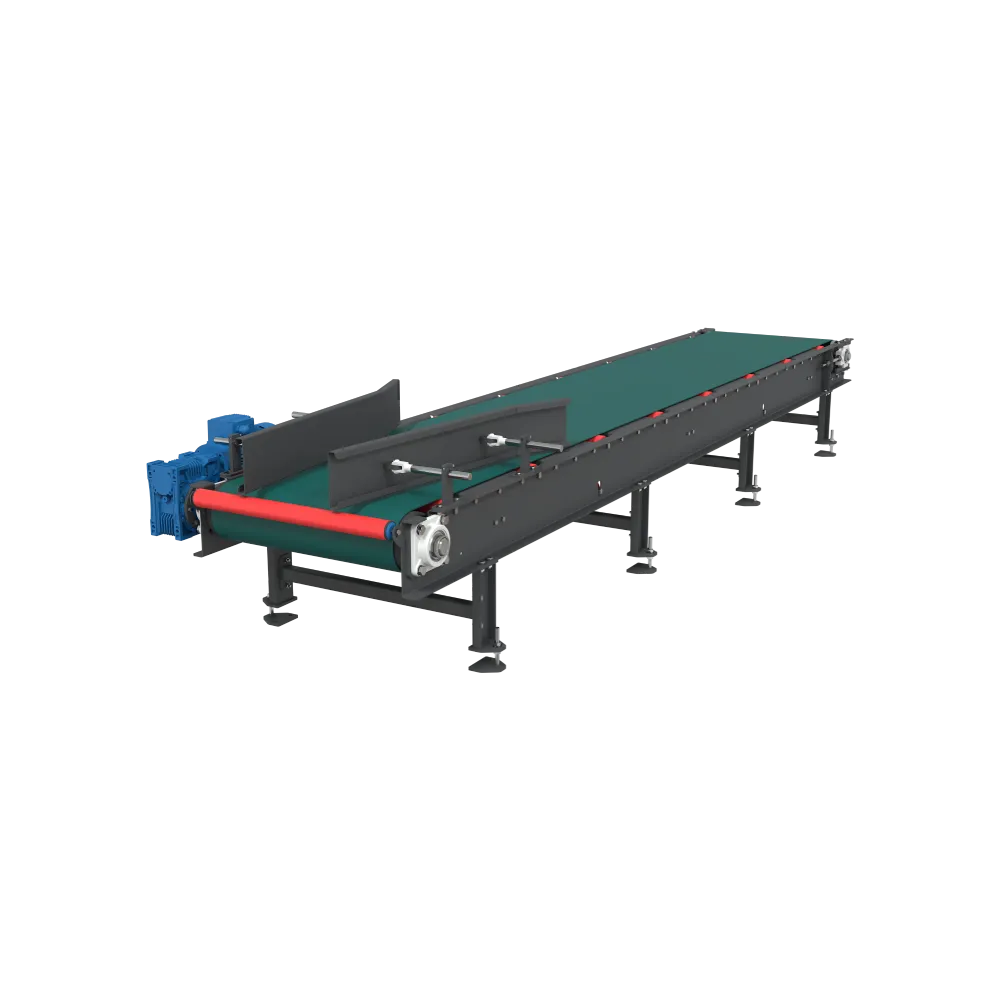
Belt conveyortransports the product safely and systematically along a specific route. However, in industrial lines, this task encompasses a broader scope. It does not conveyor simply convey; it also regulates the flow, maintains product sequencing, ensures stability at transfer points, changes product direction on some lines, and establishes the appropriate speed range for the subsequent machine. For this reason, belt conveyor, it should be viewed as the backbone of the production line..
In bagging and packaging lines, this role expands further, as it is not enough for the product simply to move forward. The bag must remain stable and maintain its orientation, and the product must arrive at the weighing, inspection, or palletizing station in the proper condition. Consequently, the choice of belt conveyor must be based on the physical behavior of the product being transported. In summary, the system manages in-line organization and synchronization alongside the conveying function.
What are the primary parameters to consider when selecting a belt conveyor?
During the selection process, the nature of the product to be transported must first be clarified. Will bags be transported, bulk material conveyed, or boxes shipped? This question determines the entire technical configuration, as the product type dictates the belt surface, required width, speed range, and routing details. Therefore, the product structure should always be the primary data point.
Secondly, capacity target must be determined. The throughput—whether in bags, tons, or units per hour—must be clearly defined,as capacity data directly influences belt width and motor selection. Thirdly, the conveying distance must be evaluated. While simple solutions may suffice for short distances, factors such as chassis structure, motor power, and bearing quality become critical over long distances. Finally, the production pace must be considered; a low-speed line and a high-intensity, continuous line cannot be planned using the same logic.
Why are belt width, belt speed, and conveying distance important?
Belt width determines how the product behaves on the conveyor. A narrow belt may compress the product, whereas a wide belt might allow for excessive movement. Therefore, the chosen width must align with the product's dimensions. For lines transporting bags, the belt widthmust ensure the bag remains stable and minimize lateral shifting during transit. In systems handling bulk material, however, the width must align with the target flow rate. Otherwise, the conveying capacity decreases.
Belt speed is equally important. Excessive speed makes product control difficult, while low speed slows down the line. Therefore, the ideal speed should not be determined solely by maximum capacity; the product's behavior on the surface must also be considered. Especially with bagged products, very high speeds can distort the bag's shape. Additionally, it can increase the risk of impact and jamming at transfer points. As the conveying distance increases, so does the system load. Consequently, long lines require a stronger chassis, a more stable tensioning structure, and a more robust drive system.
How does the nature of the product to be conveyed influence the selection process?
Not every product behaves the same way on the belt. Heavy bags and light bags do not move in the same manner. Dusty bulk material and granular material also exhibit different conveying characteristics. Therefore, the product's weight, surface behavior, and form play a decisive role in the selection process. For instance, heavy bags require a stronger chassis and a more robust belt surface. Conversely, lightweight and slippery packaging requires more controlled speeds and more stable guiding mechanisms.
The product's shape is also significant. Boxes with regular shapes are easier to transport, whereas soft bags behave differently at transfer points. Therefore, in bagging lines, the belt surface and side guiding elements must be selected carefully. For bulk materials, factors such as particle size, flowability, and the risk of spillage become more critical. When the product structure is correctly analyzed, the conveyor operates more safely, and maintenance requirements are reduced.
How are environmental conditions and durability assessed?
Belt conveyor When making a selection, the product should not be the only factor considered. Environmental conditions must also be evaluated in detail. Systems operating in dusty areas require greater protection than those in clean environments, as dust can reach bearings and accelerate wear on moving parts. Therefore, for dusty lines, and sealing details are of greater importance. Additionally, maintenance access must be easy, allowing the operator to carry out cleaning and inspection tasks more quickly.
Systems operating in humid or open-air environments also require special consideration, as environmental factors can place stress on metal surfaces and moving parts. Consequently, chassis quality, surface protection, and component durability must be considered in conjunction. Durability is not only important for longevity; it is also essential for minimizing unplanned downtime. A robustly constructed belt conveyordelivers more reliable results on continuous production lines.
Why should line integration and automation be planned together?
Modern production lines do not consist of standalone machines; each piece of equipment connects to the subsequent system. Therefore, line integration must be a key consideration when selecting a belt conveyor. The conveyor's filling system compatibility is required. Additionally, weighing unit speed synchronization is necessary. Furthermore, palletizing flow compatibility with the diversion point is required. If these connections are not established correctly, bottlenecks occur within the line. Product accumulation increases. Consequently, capacity drops.
Automation this aspect is also significant because sensors, speed control systems, and routing logic maintain the production rhythm. Especially in bagged product linesprecise timing offers a major advantage. If the bag moves at consistent intervals, downstream equipment operates more smoothly. Moreover, rejection scenarios, weight control, and end-of-line arrangements are managed more easily. Therefore, belt conveyorit should be planned not merely as mechanical equipment, but as an active part of the automation chain.
Metkan Makine belt conveyor solutions
Metkan Makine, Construction chemicals, mining and aggregate It possesses a corporate structure offering machinery solutions for various sectors. Belt conveyors hold a prominent place in its product portfolio, as conveying systems determine the flow dynamics of the production line. Crushing, Screening, Mixing, filling and palletizing It establishes a strong link between processes. Therefore, belt conveyor solutionsplay a critical role in line efficiency. When technical requirements are accurately defined, the conveyor system stabilizes the production flow.
Belt conveyor selection Capacity, product type, conveying distance, and line integration should be evaluated together during the process. Metkan Makine This approach strengthens not only equipment selection but also process integrity. The system operates more efficiently when a robust frame structure, a suitable belt surface, the right speed balance, and a configuration compatible with the production line come together. Thus, if the conveying lineit becomes a fundamental structure that supports production quality, rather than just an interconnection.
Frequently Asked Questions
What should be considered first when selecting a belt conveyor?
First, the type of product to be transported must be determined. Then, the capacity target must be clarified, as product characteristics and hourly flow data form the technical basis of the system.
Why is belt width important?
Belt width determines the product's stability on the surface. If an appropriate width is not chosen, the product may slip, jam, or move inefficiently.
How should belt speed be determined?
Speed should be determined based on the product's characteristics and the line's pace. Excessive speed makes control difficult, while excessively low speed reduces capacity.
Is a different type of conveyor required for heavy bags?
Yes, it is. Heavy bags require a stronger frame, a durable belt structure, and secure guiding features. Therefore, load specifications play a primary role in the selection process.
Does the choice of belt conveyor change in a dusty environment?
Yes, it varies. In dusty environments, sealing, bearing protection, and ease of maintenance are of greater importance. Therefore, selecting durable components becomes critical.
Why should automation be considered alongside belt conveyors?
Because speed control, sensor configuration, and the product range directly affect the production flow. The line operates more stably when supported by robust automation.
Why is line integration important?
The conveyor must operate in harmony with filling, weighing, and palletizing systems. A lack of such integration can lead to product accumulation and a loss of capacity.
What is the most common mistake made when investing in belt conveyors?
The most common mistake is focusing solely on belt length and motor power. In reality, factors such as product characteristics, environmental conditions, speed balance, and integration must all be considered together.
Metkan Makine for belt conveyor When planning the selection, factors such as product type, capacity targets, the layout of the conveying line, and process compatibility must be addressed collectively. A proper technical setup enhances line efficiency and supports operational continuity.
To determine the belt conveyor solution best suited to your production line and to plan the optimal system based on capacity and product characteristics... Contact Us