MIXING
Homogeneity in every batch
Fill level, mixing time and material properties are considered together.
 MACHINERY AND PLANT
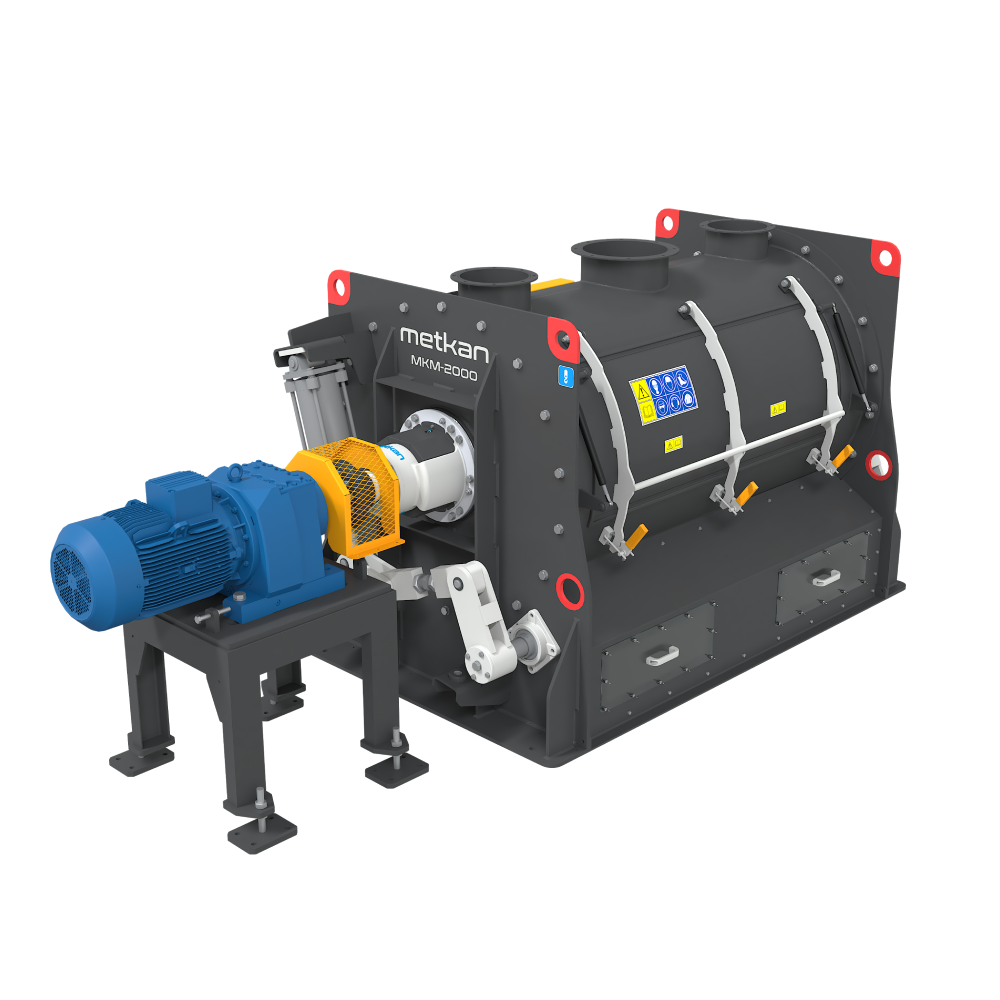
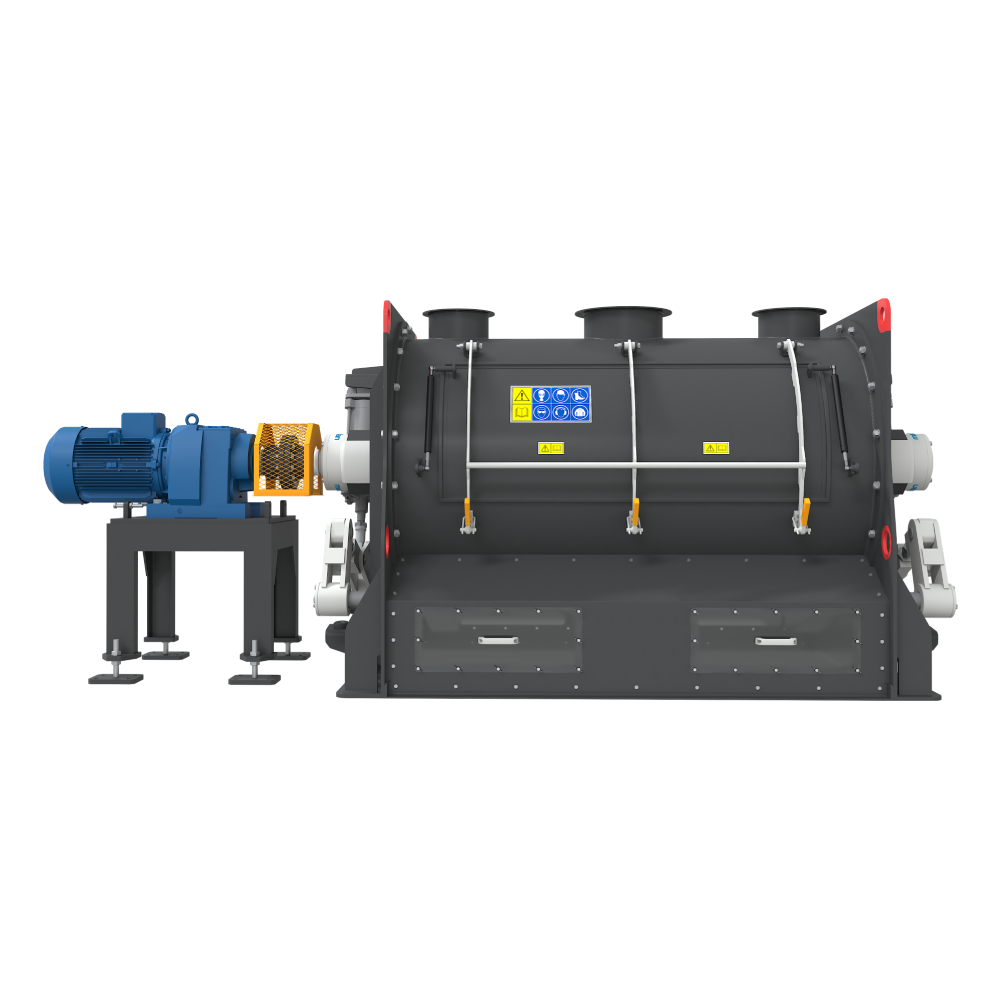
Homogeneous mixing of powder and granulated materials. Horizontal mixing solutions that address the recipe, batch volume, and discharge arrangement together.
Explore up closeMETKAN / Mixing
Fill level, mixing time and material properties are considered together.
MIXING
Fill level, mixing time and material properties are considered together.
DISCHARGE
The discharge arrangement and line connections are planned around the production sequence and cleaning requirements.
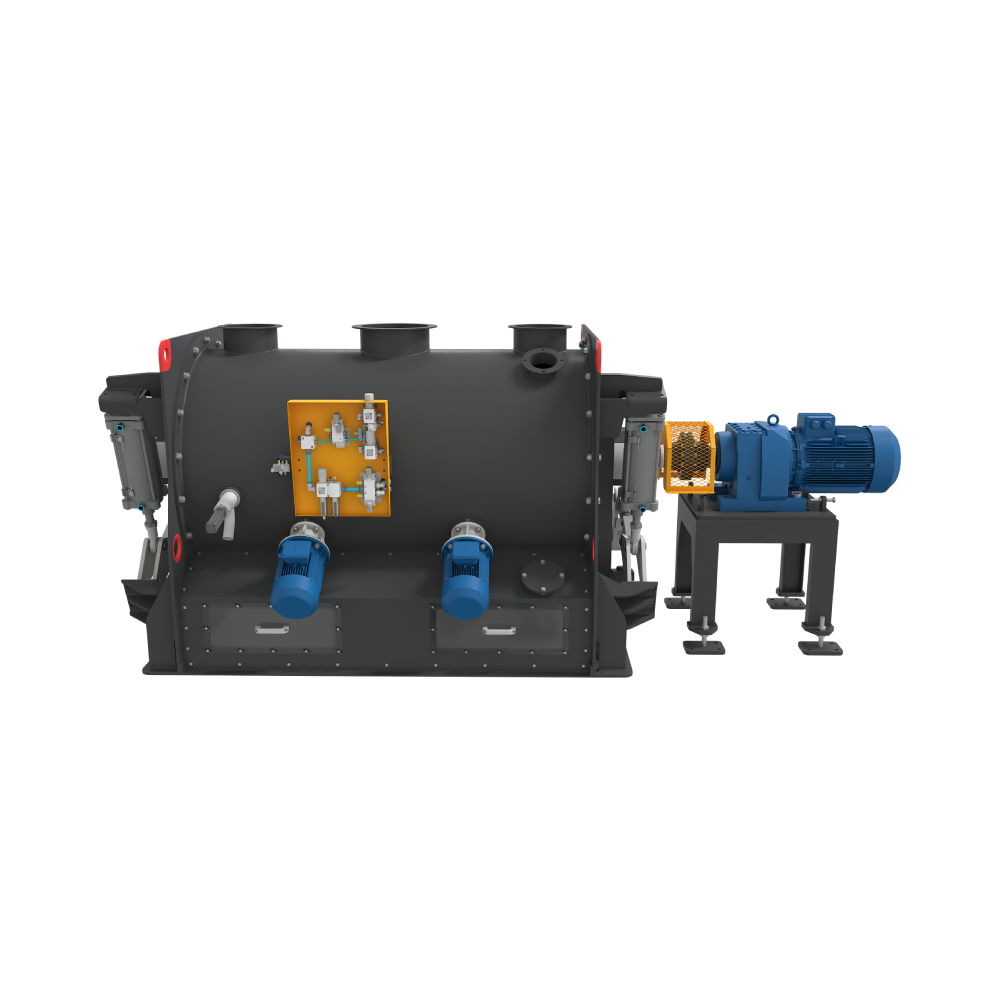
Consider capacity, structure, and dimensions together.
Your material determines the right choice.
| Technical specification | MKM-0800 | MKM-1200 | MKM-1600 | MKM-2000 | MKM-3000 |
|---|---|---|---|---|---|
| Motor powerkW | 15 - 30 | 15 - 37 | 18,5 - 45 | 22 - 55 | 30 - 55 |
| Net volumeL | 800 | 1200 | 1600 | 2000 | 3000 |
| Working volumeL (min–max) | 200 - 550 | 300 - 850 | 500 - 1150 | 550 - 1400 | 800 - 2100 |
| *Weightkg | 1400 | 2200 | 2350 | 2600 | 3400 |
| Selection for your project | Request a quote ↗ | Request a quote ↗ | Request a quote ↗ | Request a quote ↗ | Request a quote ↗ |
Technical values should be considered alongside material specifications and operating conditions.
All information in this table is for informational purposes only; it is non-binding and subject to change without prior notice. *Weights shown do not include the drive motor, support legs, or maintenance platform.
Material, capacity, and line layout. Selecting the right machine begins with understanding the entire production process.
Let's assess your needsDry mix production and formulation based processes.
Batch preparation based on material properties.
Dosing, mixing, and end-of-line integration.
TECHNICAL LIBRARY
PDF / Technical document SELECTION AND MAINTENANCE
Horizontal powder mixers are designed to mix powdered raw materials used in cement-based construction chemicals quickly and with high homogeneity. Thanks to optimized mixing paddles and a balanced operating principle, they ensure consistent quality in production processes.
Consistent quality in every batch.
Horizontal powder mixers distribute powdered raw materials evenly throughout the mixing chamber using specially designed mixing paddles. This configuration ensures the creation of a lump-free, homogeneous mixture that strictly adheres to the recipe. A homogeneous mixture directly influences final product performance, thereby guaranteeing consistent quality.
Higher production output in less time.
High-speed mixing paddles increase production rates by ensuring effective mixing in a short time. The ability to mix large volumes within minutes allows facilities to utilize their capacity efficiently. This accelerates production processes while saving energy and time.
Less residue, faster cleaning.
The mixer's interior surface features a special coating designed to prevent adhesion and residue buildup. This design minimizes mixture residue during product transitions, thereby reducing cleaning times. Production continuity is maintained through reduced downtime.
Full compatibility with modern production lines.
Designed to operate in full integration with horizontal powder mixers, weighing systems, recipe control units, and automatic discharge systems. Its modular structure offers various capacity options and allows for scalability based on facility requirements.
With its high-capacity and automation-compatible structure, it is an essential piece of equipment for modern construction chemicals facilities.
Reliably used in production lines for ceramic adhesives, tile grouts, and plasters, as well as in the manufacturing of cement-based construction chemicals, self-leveling screeds, and industrial powder mixing systems.
All information in this table is for informational purposes only; it is non-binding and subject to change without prior notice.
*The weights shown do not include the drive motor, support legs, or maintenance platform.
THE NEXT STEP
Tell us about your material and target capacity.
Let's choose the right machine for your process together.
A horizontal powder mixer, also described as a dry mix mixer or powder blender, combines the ingredients of tile adhesive, grout and cement-based render. Batch volume, low-dose additives, filling level and cleaning access must be assessed with the dosing, discharge and packing stages.
RELATED ARTICLES
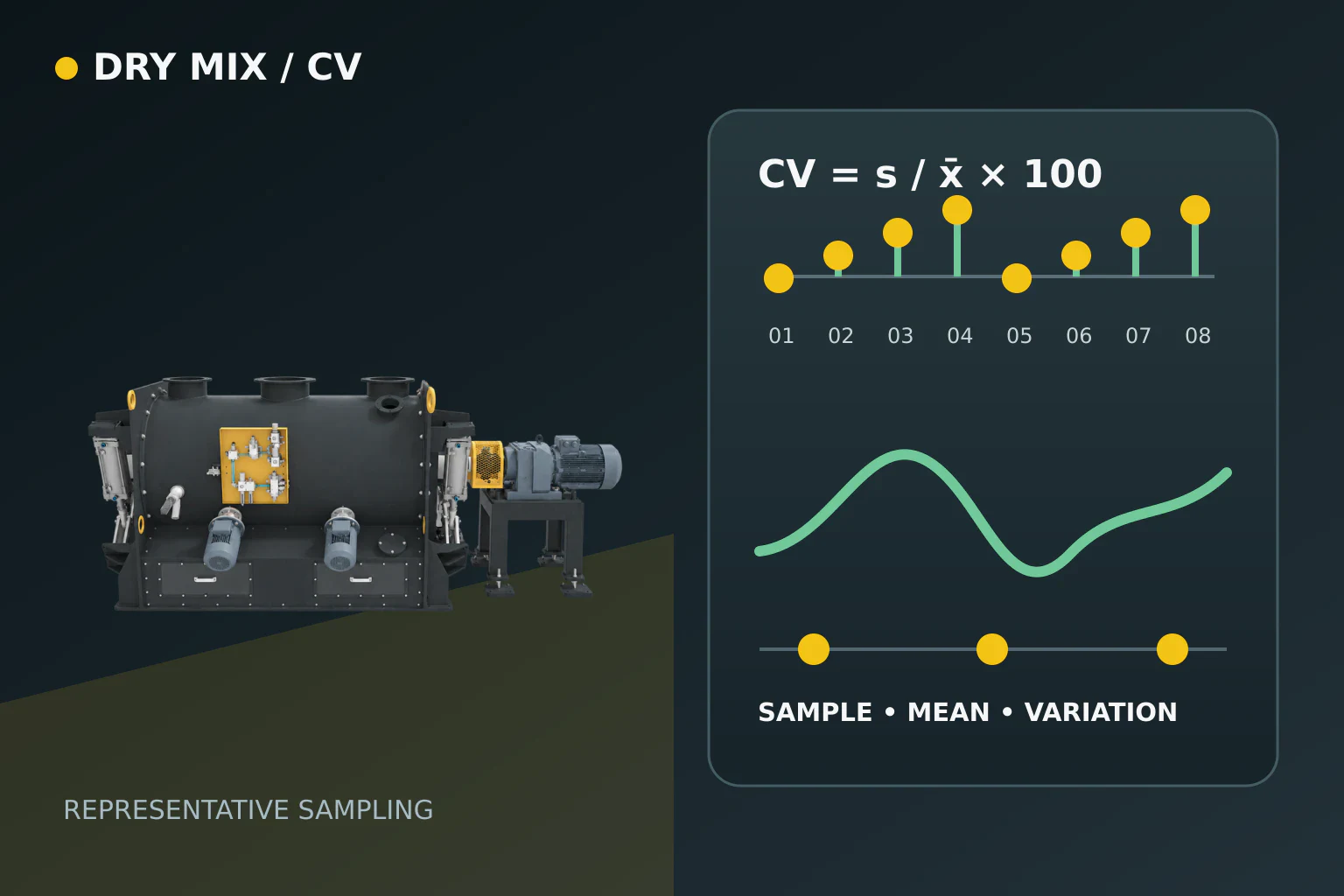
A dry blend that looks uniform does not prove that every bag has the same composition. Homogeneity verification requires a measurable marker, a representative sampling plan and one consistent analytical method. The coefficient of variation (CV) expresses the spread among samples relative to their mean. The number alone is not mixer performance, because sampling and laboratory error also affect it.
Read the technical articleA dry-mortar sample taken at the mixer may be satisfactory while the first and last bags differ in composition. Increasing mixing time at this point is an intervention made before locating the problem. Dry-blend segregation, meaning the separation of previously mixed components, can develop during downstream handling. This guide offers a diagnostic approach from mixer discharge to bagging to identify where the blend changes.
Read the technical articleThe choice of a horizontal powder mixer directly impacts the mixing quality of the production line. Selecting the wrong capacity or motor extends production time; it also increases energy consumption and negatively affects mixture homogeneity. Therefore, businesses should not focus solely on mixer volume. While vessel volume determines the amount of product processed in a single batch and motor power enables the mixing system to generate the necessary motion, these two values alone do not define the correct mixer selection. Product density, flow characteristics, and target capacity are also crucial factors.
Read the technical articleIn facilities producing construction chemicals, dry mortar, and industrial powders, the mixing process is one of the most critical stages determining product quality. No matter how high the quality of the raw materials used in the production line, the desired product performance cannot be achieved if they are not evenly distributed within the mixture. Cement-based products, joint fillers, tile adhesives, plaster additives, and specialty dry mixes, in particular, require a high degree of homogeneity. Having an excess of additives in one bag while another lacks them directly compromises product quality. Therefore, manufacturers should not focus solely on increasing capacity but must also continuously monitor mixture quality. Facilities that achieve a homogeneous mixture using horizontal powder mixers ensure more stable production, streamline quality control processes, and boost customer satisfaction. Consequently, the performance of the horizontal powder mixer is a fundamental factor determining the overall success of the production line.
Read the technical articleRecipe changeovers and cleaning in a dry mix plant should be planned by considering product quality, production continuity and the risk of cross-contamination together. The best approach is to sequence recipes according to ingredient similarity and cleaning requirements, control material remaining in the line during changeover, and establish a practical cleaning plan for each product group.
Read the technical article