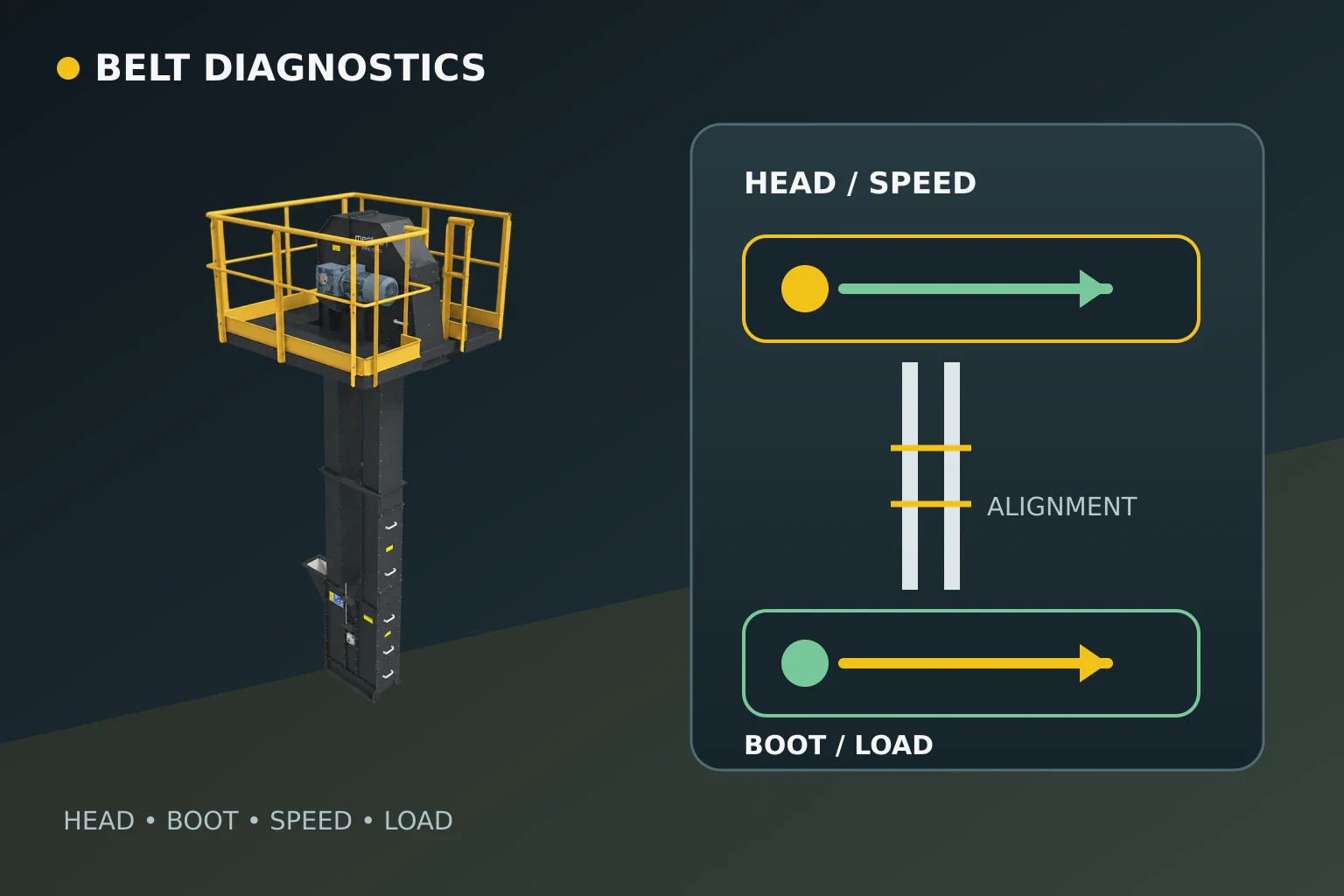
Belt misalignment and speed loss can occur together in a bucket elevator, but they are not the same fault. Misalignment means that a belt edge approaches a pulley or casing; speed loss can point to slip between drive and belt, overload or a transmission problem. Diagnosis starts by reading head and boot position signals, belt speed, motor load and the operating condition in which the event occurs, rather than relying on one alarm.
Separate alarm location and timing first
A misalignment signal only at the head calls for inspection around the head-pulley lagging, pulley axis, build-up and upper-shaft alignment. A signal only at the boot shifts attention to the boot pulley, take-up, inlet and material accumulation in the lower casing. Head and boot signals on the same side call for checking the full-line geometry, belt splice and casing plumb. These patterns are not verdicts; they narrow the order of inspection.
If the alarm occurs only under load, examine whether feed is distributed evenly to the belt and buckets. Pulsing or one-sided feed can alter the material bed around the boot pulley and push the belt sideways. Misalignment that persists when empty gives more weight to geometry and mechanical adjustment. Recording product, feed condition, start-stop phase and load state reveals repeated patterns.
| Observation | Priority cause group | Verification |
|---|---|---|
| Misalignment only at head | head pulley, lagging, upper shaft | marks, build-up and axis measurement |
| Misalignment only at boot | boot pulley, take-up, feed | take-up travel and material bed |
| Belt slows, drive stable | slip, contact or take-up | compare both speed signals on one timeline |
| Alarm only under load | feed distribution, build-up, tension | compare empty and controlled-load records |
Verify speed loss separately from the misalignment alarm
Compare the speed-sensor reading with drive speed. If drive speed is maintained while belt speed falls, investigate slip, insufficient contact or take-up behaviour. If drive and belt speed fall together, examine overload, motor-drive, gearbox or coupling. A misalignment signal without a speed change prioritises position and mechanical alignment. Sensor-target contamination, gap and scaling must also be verified before declaring a mechanical fault.
Use a trend record instead of one instantaneous value. When belt-speed ratio, misalignment-switch events, motor current, bearing temperature and vibration share a timeline, the order of events becomes visible. Peer-reviewed research shows that vibration indicators can provide preliminary assessment of a loose or deformed belt and misaligned buckets, but do not identify the exact failed component alone. Motor-current-based belt monitoring is also possible, but it requires reference data and field validation.
When searching for root cause, divide measurements into start-up, steady operation and the period before shutdown. Misalignment in the first minutes may relate to take-up movement, cold-belt behaviour or the start sequence. A deviation that grows slowly during steady running can indicate build-up, temperature-related geometry change or gradual loosening. For a sudden isolated event, investigate a foreign object, pulsing feed or sensor contact. Using the same product and similar feed conditions in each trial separates the effect of one adjustment from other variables. If the alarm record and physical evidence do not agree on side and time, first verify sensor mounting, wiring and the PLC tag assignment. Mechanical intervention should follow confirmation of the measurement chain.
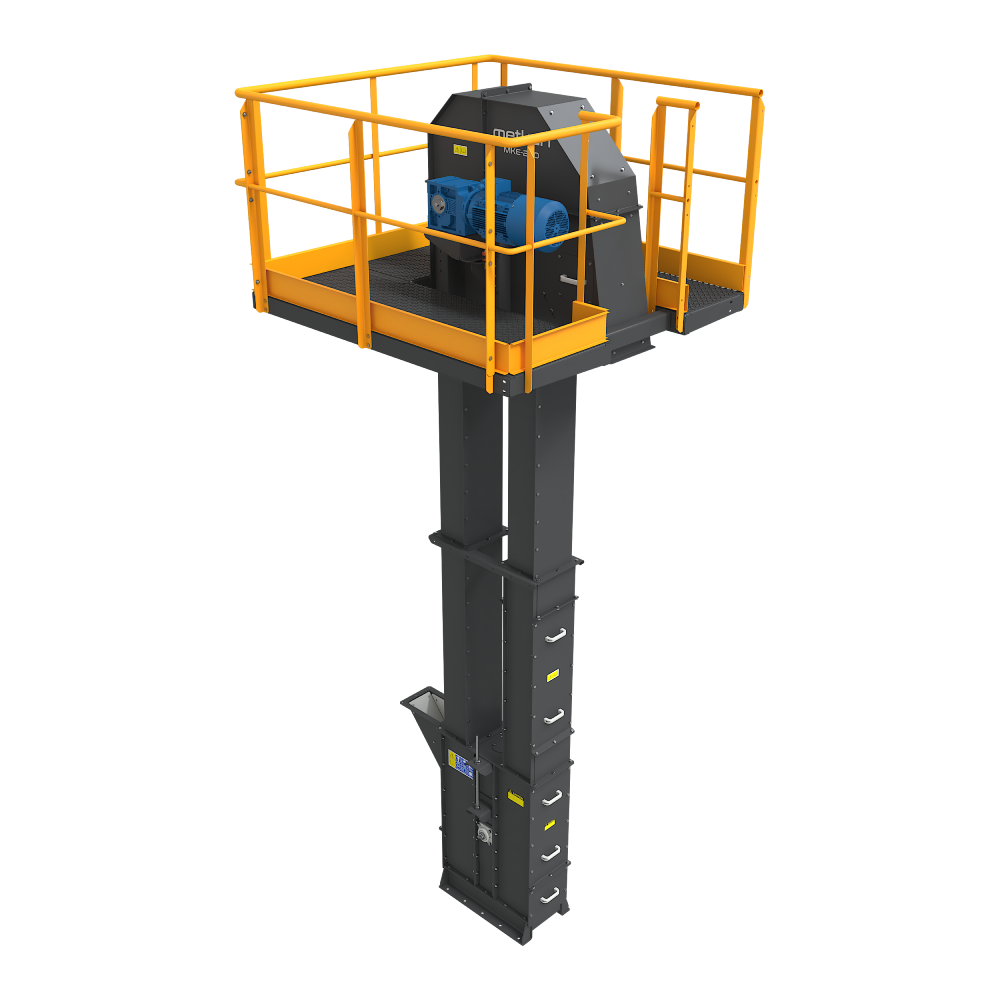
Do not copy an alarm threshold from another plant
The US OSHA rule for grain facilities requires shutdown at no more than a 20 percent reduction from normal belt speed and belt-alignment monitoring for specified inside bucket elevators. This is not a universal setting for every sector or every Metkan elevator. The HSE also recommends underspeed and alignment monitoring in a food/dust-explosion context. Alarm and shutdown values must be defined for the plant from material, elevator design, sensor resolution, site risk assessment and applicable rules.
Physical inspection must take place only after the site’s authorised isolation and access rules have been applied. Document marks at head and boot covers, belt-edge wear, bucket fasteners, splice, pulley surface and take-up travel against the same event record. Measure the current position before changing an adjustment; then make one change and compare the result empty and under controlled load. Safety procedures and authorisation remain the site’s responsibility.
What data are needed for technical assessment?
For a technical assessment, prepare elevator height, belt width and construction, bucket type and spacing, pulley diameters, drive speed, take-up arrangement, conveyed material, feed method, normal operating range and event logs. Photos of the head and boot with sensor positions also narrow the possibilities. Record the date of the last changed part, adjustment and belt splice to connect the event with maintenance work. Metkan’s bucket-elevator and automation pages show equipment and monitoring scope; contacting Metkan with current line data makes the review concrete.
Sources and scope limits
Sources were checked on 3 November 2026. OSHA and HSE provisions belong to grain/food and dust-explosion contexts and do not transfer a universal alarm value to other sectors. The ISO page confirms the official scope. Peer-reviewed studies support vibration and motor-current condition monitoring, but do not prove a field fault from one signal. Standards are not reproduced.
- OSHA 29 CFR 1910.272 — bucket-elevator monitoring provisions for grain facilities
- HSE — underspeed and alignment monitoring approach in the food sector
- ISO 7149:1982 — scope of the safety code for continuous mechanical handling equipment
- Będkowski et al. — vibration-based diagnostic indicators for bucket elevators
- Khodabakhshian et al. — belt mis-tracking detection from motor current