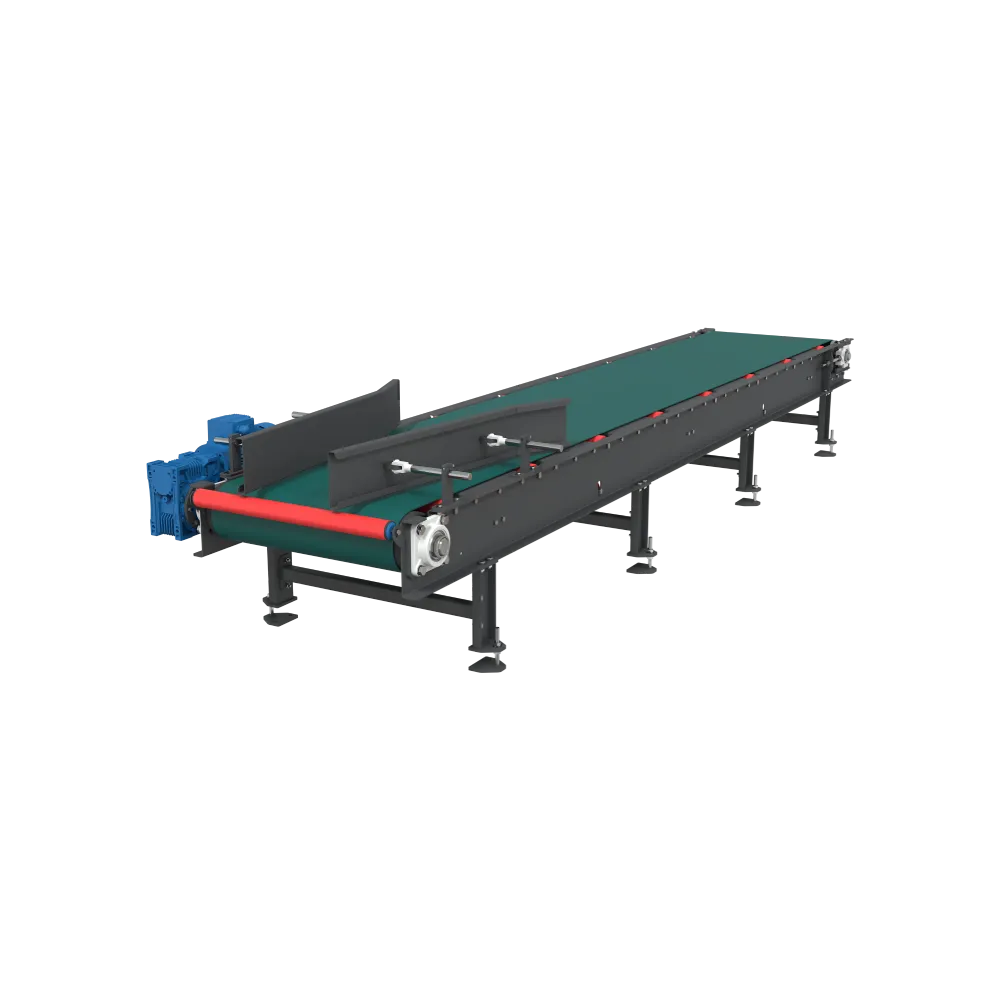
How are belt conveyor length and width determined? This question represents one of the most critical technical decisions for businesses establishing a production line. Because belt conveyor it does not just convey products; it also determines the line rhythm, product flow pattern, and the operating pace of downstream equipment. An incorrectly sized belt conveyorresults in capacity loss, leads to product accumulation, and creates imbalances along the line. Conversely, a correctly sized system balances the flow, ensures safe product transfer, and boosts operational efficiency. Therefore, belt conveyor dimensions are not determined solely by looking at the available space. Factors such as the type of product to be transported, capacity targets, line direction, speed, load distribution, and site layout are all evaluated together.
This becomes Construction chemicals, bagging lines, Crushing and screening plants and end-of-line automation systems belt conveyor dimensions where this becomes even more critical. This is because the product may move in bags, be transported as bulk material, or require controlled transfer between weighing and palletizing stations. Therefore, the same length and width do not yield the correct result for every process. A sound engineering approach belt conveyor length and width not merely as machine dimensions, but treats them as requirements dictated by the flow of the entire system. For Metkan Makine, selecting the right conveyor embodies precisely this approach: establishing a system that integrates with the line, maintains product flow, and operates efficiently over the long term.
Contents
- Why must belt conveyor dimensions be determined accurately?
- Based on what data is the belt conveyor length calculated?
- Which technical criteria influence the choice of belt width?
- How does the nature of the product being transported affect belt dimensions?
- How do capacity targets determine belt conveyor dimensions?
- How do line layout and changes in direction affect length calculations?
- Why do dimension choices differ between bagged products and bulk materials?
- How is the relationship between motor power, speed, and belt dimensions established?
- What are the most common errors made when selecting belt conveyor dimensions?
- What benefits does correct sizing bring to the production line?
- Frequently Asked Questions
Why must belt conveyor dimensions be determined accurately?
Belt conveyor dimensions If belt conveyor dimensions are not determined correctly, the entire line is affected. This is because if the product does not move through sufficient space, accumulation occurs, flow becomes irregular, and downstream equipment fails to receive a steady feed. Selecting a belt that is too narrow causes the product to spill over the sides or results in the irregular movement of bags. Conversely, a line that is longer than necessary compromises space utilization, incurs unnecessary costs, and increases the maintenance burden. Therefore, proper sizing plays a critical role not only in ease of installation but also in production efficiency.
Correct sizing also ensures safety and maintenance discipline. When the product moves stably along the belt, the need for operator intervention is reduced. Bags move more steadily at points where the direction changes. Bulk material does not spill over the sides. Consequently, the line operates more cleanly and systematically. For Metkan Makine, belt conveyorit is not merely a piece of conveying equipment; it is one of the core systems that sustains process continuity. Therefore, the selection of length and width must be treated as one of the initial technical decisions regarding the investment.
Based on what data is the belt conveyor length calculated?
Belt conveyor length is primarily determined by the actual conveying distance between two points. However, this calculation is not based solely on a straight-line approach. Factors such as the product's starting and ending points, loading and unloading zones, any changes in direction, and equipment connections are all evaluated together. This is because the belt does not simply transport material from one place to another; it also conveys the production flow within a specific, organized framework. For this reason, the technical team first clarifies where the line will begin and where it will connect.
Site layout plays a decisive role in calculating length. Confined spaces, column placement, platform crossings, maintenance clearances, and operator access points alter the actual belt length. A distance that appears short on paper can translate into a much longer line on-site. Conversely, some lines may end up with excessive length, extending the product conveying time. Therefore, the correct approach is to determine the length based on the process layout rather than just a linear measurement. For this reason, Metkan Makine evaluates the conveyor plan based on the actual function the line performs.
Which technical criteria influence the choice of belt width?
Belt width The primary factor determining the choice is the physical nature of the product to be transported. If the product moves in bags, the bag width, bag shape, and behavior on the conveyor become key criteria. If bulk material is being transported, factors such as particle size, pile height, and flow characteristics come into play. A belt that is too narrow restricts product movement, while an excessively wide belt increases costs and consumes unnecessary space in certain lines. Consequently, the decision regarding width is made based directly on the product's characteristics.
The second critical factor is the target capacity. When the same product is transported at different flow rates, the required belt width also changes. A narrower system suffices for low-volume lines, whereas lines requiring high flow rates need a wider surface area. Additionally, the required stability of the product on the belt is taken into account; for instance, in lines preceding bagging and palletizing, the arrangement of the bags must remain undisturbed. Therefore, belt widththe width should be determined not merely by asking "will the product fit?" but by considering "how controlled is the product's movement?"
How does the nature of the product being transported affect belt dimensions?
The product structure belt conveyor dimensionsis the primary determinant. Powder and granular products behave differently on the conveyor belt; bulk material advances by building up height, whereas bagged products require dimensional stability regarding width. For boxed and packaged goods, bottom-surface stability is the key factor. Consequently, not all product groups can be transported using the same belt specifications; the product's width, length, weight, surface characteristics, and flow behavior are all evaluated together.
Width calculations require particular care, especially for bagged products. This is because a bag does not merely occupy space on the belt; it also exhibits slight deviations during movement. If the belt is too narrow, the bag will not travel straight, causing issues prior to weighing and palletizing. For bulk materials, the product's piling behavior and the risk of spillage are taken into account. For this reason, Metkan Makine belt conveyor dimensionsdetermines specifications based on the specific product group, as the same conveyor structure does not yield identical performance across different products.
How do capacity targets determine belt conveyor dimensions?
The capacity target directly influences the dimensions of the belt conveyor.This is because the surface area and length are planned according to the volume of product the belt is required to transport. As the hourly flow rate increases, more product moves along the belt. Therefore, the width must allow for comfortable transport, and the length must be sufficient to support this flow. Oversizing a low-capacity line can result in unnecessary investment, while undersizing a high-capacity line creates a bottleneck.
Relying solely on theoretical capacity is insufficient here; factors such as instantaneous load variations, shift intensity, and fluctuations in product flow must also be considered. Some lines operate under a constant load, while others experience periods of high intensity. A sound capacity plan accounts for these differences. When determining belt conveyor dimensions, Metkan Makine considers daily and hourly production targets, product type, and in-line synchronization collectively. A correct capacity decision does more than just operate the conveyor; it maintains the rhythm of the entire production line.
How do line layout and changes in direction affect length calculations?
The layout of the line plays a direct role in calculating the belt conveyor length. This is because the product often does not travel along a single straight line. The infeed point, diversion area, weighing station, bag straightening area, and palletizing line may be located at different positions. Consequently, the conveyor sometimes runs straight, sometimes turns, and sometimes approaches other equipment while maintaining a controlled distance. This configuration directly affects the calculation of the actual length.
Product flow is disrupted when changes in direction and connection points are poorly planned. Transitions designed to be too short cause product accumulation, while unnecessarily long layouts reduce space utilization and extend product transfer times. Therefore, conveyor length is not determined solely by the gap between two points; site realities, operator pathways, maintenance access, and line synchronization also factor into the calculation. For this reason, Metkan Makine designs conveyor layouts in conjunction with product flow, integrating conveying principles with the site plan.
Why do dimension choices differ between bagged products and bulk materials?
Bagged products and bulk materials require different conveying logics. A bag moves along the belt with a specific footprint and requires directional stability. Bulk material, on the other hand, forms a pile on the belt and carries the risk of lateral spreading. Consequently, the same width and length do not yield the same results for these two different product groups. For bagged products, maintaining shape and ensuring aligned movement are paramount, whereas for bulk materials, load distribution and spillage control become more critical.
In bagging lines, belt width specifications are generally determined by the need for safe product movement. The product must remain orderly prior to weighing, alignment, and palletizing. With bulk materials, however, pile height, flow rate, and the discharge zone are the determining factors. Therefore, the product group must be clearly defined before selecting a conveyor, and sizing must be based on this data. Metkan Makine treats the flow of bagged products and the conveying of bulk materials as distinct technical categories, particularly in end-of-line applications. This approach directly enhances system efficiency.
How is the relationship between motor power, speed, and belt dimensions established?
Motor power, belt speed, and dimension selection are interdependent. This is because belt width as dimensions increase and the conveying load rises, the total load the system must carry also increases. When length increases, friction, load, and operational behavior change. When speed increases, the product's movement on the belt changes. Therefore, belt dimensions are not determined in isolation; they are evaluated in conjunction with motor power and speed.
High speed does not always offer an advantage, as some products lose their alignment during rapid flow. With bagged products in particular, excessive speed can disrupt alignment prior to palletizing. With bulk material, product scattering can occur. Conversely, low speed limits capacity. A sound engineering approach strikes a balance between speed and dimensions. For Metkan Makine, the correct belt conveyor selectionsignifies not merely mechanical conveying power, but also controlled flow and system compatibility. For this reason, motor, speed, and dimensions are evaluated within the same calculation.
What are the most common errors made when selecting belt conveyor dimensions?
The most common mistake is determining belt dimensions based solely on the available space and product width. However, product behavior, capacity targets, line direction, and the interface with downstream equipment are equally important. Another error is applying the same logic to both bagged products and bulk material; this approach creates irregularities along the line. Furthermore, some businesses make selections based only on current capacity, overlooking the potential for future growth. This necessitates a future line revision.
Another common mistake is considering the conveyor in isolation. However, conveyor it often operates in conjunction with weighing, bag straightening, palletizing, or other conveyor lines. If line synchronization is poorly established, the system fails to deliver efficiency, even if the dimensions appear correct. Therefore, how the length and width of a belt conveyor are determined —the correct answer to this question lies not merely in dimensional calculations, but in evaluating the entire process holistically.
What benefits does correct sizing bring to the production line?
Proper sizing first ensures a stable flow within the production line. The product moves more steadily along the belt. Downstream equipment receives a consistent feed. Orderliness is maintained during bagging and palletizing. Product loss is reduced when handling bulk materials. Operator intervention is minimized. This orderliness directly boosts production efficiency, as the conveyor does more than just transport material; it carries the rhythm of the entire line from one point to another.
Furthermore, selecting the right dimensions maintains investment discipline. An unnecessarily large system does not inflate the budget, nor does an undersized system create future bottlenecks. Maintenance planning becomes more controlled, space utilization more efficient, and the system more sustainable. For this reason, Metkan Makine does not view conveyor dimensions merely as machine specifications; it treats them as the "flow language" of the production line. Accurate sizing constitutes one of the most critical technical decisions within this language.
Frequently Asked Questions
How is the belt conveyor length determined?
Belt conveyor lengthIt is determined based on the actual conveying distance between the start and end points. However, the calculation is not based solely on a straight line; the loading area, discharge zone, directional changes, maintenance clearances, and site layout must all be considered together. A sound length calculation integrates the process flow with the actual on-site layout.
What factors determine the belt conveyor width?
Belt width Selection is based on the type, width, and bulk behavior of the product to be transported, as well as capacity targets. For bagged products, shape stability and safe conveying are paramount. For bulk materials, load distribution and the risk of spillage over the sides are taken into account. The correct width ensures the product moves along the belt in a controlled manner.
Why is belt width important for bagged products?
Bagged products do not merely occupy space on the belt; they also exhibit slight deviations during movement. If the belt is too narrow, the bag may travel crookedly, potentially disrupting the alignment required prior to palletizing. When the width is selected correctly, the bag moves more stably, and errors in weighing and guiding are reduced. Therefore, the decision regarding width on bagging lines directly impacts quality.
Can bulk material and bagged products be transported on the same conveyor belt?
It may be technically possible; however, since product behavior differs, the same system will not yield the same efficiency under all conditions. Bagged products require surface stability, whereas bulk material exhibits pile behavior. Therefore, product type and intended use must be evaluated together when making a selection.
Does the belt width always increase as capacity increases?
In most cases, the width increases; however, capacity is not the sole determining factor. Product type, belt speed, load density, and line layout also influence the decision. Some systems find solutions by adjusting speed and layout, while other lines require a wider belt. A sound decision is reached when all technical data are analyzed together.
What happens if the belt length chosen is excessive?
A belt that is longer than necessary compromises space utilization, increases investment costs, and—on some lines—prolongs product transfer times. It can also increase the maintenance and cleaning workload. Therefore, the length should be determined based on the actual site configuration rather than simply exceeding requirements.
What is the most common mistake made when selecting belt conveyor dimensions?
The most common mistake is determining dimensions based solely on the clear span and product width. However, capacity targets, product behavior, changes in direction, and end-of-line equipment are equally important. Evaluating the conveyor in isolation is another frequent error.
What benefits does the correct belt conveyor size bring to production?
The correct size ensures safe and stable product transport. It reduces line congestion, ensures a steady flow to downstream equipment, and maintains the production rhythm. It also balances the investment budget, facilitates maintenance, and delivers long-term efficiency to the production line.
Metkan Makine with Belt conveyor suitable for your production line By accurately planning the length and width, you can establish a more balanced, controlled, and efficient conveying flow. To evaluate the optimal conveyor structure, line layout, and capacity balance for your project together... please contact us..