What is a screw conveyor? It conveys powder and granular materials along a production line in a controlled manner. This system does not merely transfer material; it also maintains the feeding pattern, balances the dosing flow, and supports process continuity. Especially in Construction chemicals, cement, animal feed, food and chemical sectors, a steady flow of raw materials is crucial, as the production line operates efficiently only with stable feeding. Therefore, selecting a screw conveyor requires careful consideration not only of capacity and conveying distance but also of material characteristics, conveying angle, and line compatibility.
A properly planned The screw conveyor systemstrengthens flow stability during the production process and reduces the need for operator intervention. It also aids in dust control, simplifies maintenance, and establishes a more stable operating routine across the line. Screw diameter, pitch, rotational speed and casing type Technical details such as these directly impact system performance. This content provides a detailed overview of what a screw conveyor is, its function, how it operates, and the key technical criteria to consider during the selection process.
Contents
- What is a screw conveyor?
- What is the function of a screw conveyor?
- How does a screw conveyor work?
- In which sectors are screw conveyors used?
- What factors should be considered when selecting a screw conveyor?
- How do screw diameter, pitch, and rotational speed affect capacity?
- What is the difference between a tubular and a U-trough screw conveyor?
- What are the key points in screw conveyor maintenance?
- Metkan Makine screw conveyor solutions
- Frequently Asked Questions
What is a screw conveyor?
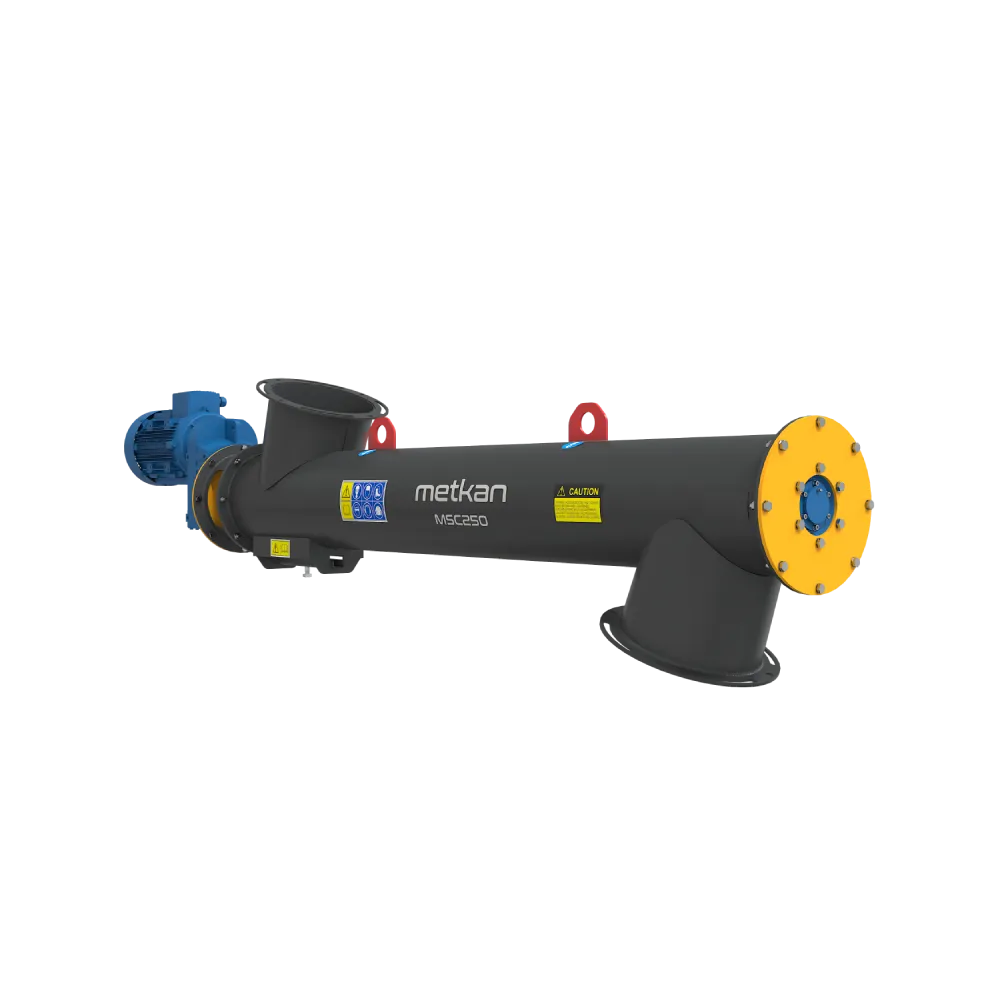
Screw conveyorIt is a mechanical conveying system that operates using a spiral flight structure. The system moves material forward within the casing. This assembly primarily consists of a motor, a gearbox, a shaft, a spiral screw, and the casing. The motor generates motion; the gearbox reduces this motion to the appropriate speed; and the spiral flight advances the material from the inlet to the outlet. While the operating principle appears simple, actual performance is determined by technical details—foremost among them being screw diameter, pitch, rotational speed, casing type, and conveying angle.
This system excels particularly with powdery and granular products, as its enclosed or semi-enclosed casing structure allows for more controlled material transport and minimizes dust leakage. This advantage makes a significant difference, especially in construction chemical and cement processing lines—such as in under-silo feeding, bunker discharge, mixer filling, and packaging line applications. screw conveyor It is used not merely for material conveyance; it also establishes a balanced flow within the process and contributes to the smooth operation of the line.
What is the function of a screw conveyor?
The primary function of the screw conveyor is to transport material in a controlled manner. However, the system's role extends beyond this; it maintains the feeding sequence, stabilizes the dosing flow, and ensures a more consistent delivery of the product to mixers, elevators, hoppers, or filling lines. In this respect, it plays an active role in the production process. This contribution is particularly evident in lines requiring high recipe precision, as a constant flow directly impacts mixture quality and production rhythm.
Screw conveyor When selected correctly, the raw material flow becomes regulated, the risk of sudden overloading decreases, and the need for operator intervention is reduced. This outcome not only enhances operational convenience but also supports quality standards. The enclosed housing offers significant advantages for dusty products, while ensuring steady transport for granular materials. By combining feeding and dosing functions, the system contributes to the more stable operation of the production line. Therefore, screw conveyorit is important not only for material transfer but also for process control.
How does a screw conveyor work?
Screw conveyorIt operates via the rotational motion generated by the motor. This motion is transmitted to the screw shaft through a gearbox. As the spiral flight begins to rotate, the material is pushed forward within the housing, moving the product from the inlet to the discharge point. The system can be installed horizontally or at an incline; however, conveyance resistance increases as the installation angle rises. Consequently, capacity calculations require greater care in inclined applications.
Operational efficiency is not determined solely by the motor. The screw diameter affects the volume being conveyed. The pitch determines the material's flow pattern. Rotational speed establishes the balance between speed and control; excessively high speeds can cause irregular flow in certain products, while very low speeds limit capacity. Therefore, these three parameters must be evaluated together during the technical selection process. Additionally, material density, particle size, and moisture content alter operational behavior. The right system is determined by taking these data points into account.
In which sectors are screw conveyors used?
Screw conveyorIt is widely used in sectors involving significant quantities of powdered and granular raw materials. Construction chemicals production is a primary example, as materials such as cement, gypsum, calcite, filler minerals, and additives require consistent conveyance. Cement production shares similar requirements. Furthermore, the animal feed, food, and chemical industries also make extensive use of this system. For any production line requiring controlled product flow, screw conveyor it offers a robust solution.
Each sector entails different technical expectations. In construction chemicals, dust control and dosing precision are paramount. In the food industry, hygiene and product safety take precedence. In the chemical sector, material compatibility, sealing integrity, and safe conveyance are the deciding factors. Consequently, the sector name alone is insufficient; the material type, operating environment, and process objectives must be evaluated collectively. Selecting the appropriate system enhances conveyance quality and makes maintenance requirements more manageable.
What factors should be considered when selecting a screw conveyor?
The first step is to clearly define the material to be conveyed. Is the material a powder or a granule? Is it moist or abrasive? The answers to these questions directly influence the design. Abrasive products require more durable screw flights. Moist products carry a risk of adhesion and clogging. Dense materials demand a more powerful motor and a sturdier casing. Therefore, the selection process must always begin with material analysis.
The second step is calculating capacity. The hourly volume of material to be conveyed must be clearly defined. Next, the conveying distance and installation angle must be evaluated, as short and long lines do not impose the same mechanical loads, nor do horizontal and inclined conveying yield identical results. The third step is selecting the casing type. A tubular structure offers advantages if dust control is a priority, whereas a U-trough design may be more suitable if access for maintenance and cleaning is the primary concern. Finally, the maintenance plan must be considered; easily detachable connections and an accessible internal structure provide significant operational advantages.
How do screw diameter, pitch, and rotational speed affect capacity?
As the screw diameter increases, the theoretical conveying volume rises. However, diameter alone does not determine capacity; the pitch measurement is equally important. Pitch refers to the distance between the spiral flights. An appropriate pitch helps the material move more steadily. Rotational speed affects the conveying rate; increasing the speed can boost throughput. However, excessive speed can lead to a loss of control with certain products, as well as irregular flow and increased wear.
Therefore, capacity calculations should not be based on a single parameter; diameter, pitch, and rotational speed must be evaluated together. Additionally, material density, flow characteristics, and the conveying angle influence the outcome. The same screw diameter can yield different capacities depending on the product. A technically accurate result is achieved by considering all these data points in conjunction. If a production line requires high capacity, the system must deliver it consistently—without compromising control. A successful selection strikes precisely this balance.
What is the difference between a tubular and a U-trough screw conveyor?
Tubular screw conveyorfeatures an enclosed housing structure. This design offers significant advantages for dusty products, as it allows for more controlled material transport and reduces dust emissions into the surrounding environment. This feature is highly valuable for construction chemicals, cement, and similar products. The enclosed system is also less susceptible to external factors, making the tubular solution an ideal choice for lines requiring clean and controlled conveying.
U-trough screw conveyor offers advantages regarding access for maintenance and cleaning. Its design, featuring a top cover, allows for easier access to the interior. This feature offers significant convenience for lines requiring frequent product changes or regular cleaning. However, the selection should not be based solely on ease of maintenance; factors such as dust control, material type, conveying angle, and process requirements must be evaluated together. Accurately assessing technical needs allows for a clearer determination of the appropriate casing type.
What are the key points in screw conveyor maintenance?
Ease of access is a primary consideration during maintenance, as difficult maintenance translates to prolonged downtime. Consequently, features such as flanged connections, removable components, and an accessible casing design offer significant advantages. Operations require less time for maintenance, and internal cleaning and inspection tasks become more efficient. This is particularly crucial for lines that operate continuously.
The second consideration is wear. Hard, mineral-based products, in particular, cause gradual wear on the screw flight and casing surface; therefore, an abrasion-resistant design supports long-term efficiency. The third consideration involves the motor, gearbox, bearings, and sealing components. These parts require regular inspection, as unplanned breakdowns can impact the entire line. A proper maintenance plan extends system lifespan and strengthens production continuity. Thus, maintenance is a technical aspect just as critical as capacity.
Metkan Makine screw conveyor solutions
Metkan Makine Construction chemicals, mining and aggregate ...is a corporate brand offering machinery solutions for various sectors. Screw conveyors play a significant role in its product portfolio, as conveying systems for powdered and granular materials directly influence the flow of the production line. Proper planning of conveying systems is essential to establish seamless integration between crushing, screening, mixing, conveying, and palletizing processes. Therefore, screw conveyor...must be evaluated within the context of overall process integrity.
Metkan Makine for screw conveyor Selection must be considered in conjunction with capacity, material type, housing type, maintenance access, and process compatibility. A correct technical configuration ensures a more stable flow within the production line. It also enhances feeding and dosing processes. Thus, the system does not merely perform a conveying function; it also supports a controlled production structure. This is where the technical approach characteristic of Metkan Makine becomes evident: machine selection, process requirements must be planned together.
Frequently Asked Questions
What is a screw conveyor?
Screw conveyoris a mechanical conveying system that transports powder and granular materials along the line using a spiral flight structure. The motor rotates the auger shaft, and the spiral structure advances the material from the inlet to the outlet. In the production line, this system does not only perform a conveying function; it also supports the feeding arrangement and renders the process flow more controlled.
What is the function of a screw conveyor?
The screw conveyor ensures a steady and controlled flow of raw materials. This allows mixers, hoppers, elevators, or filling systems to operate more consistently. Additionally, the system maintains dosing balance, minimizes sudden product accumulation, and reduces the need for operator intervention. These advantages directly lead to increased quality and efficiency, particularly in powder-based production lines.
For which materials is the screw conveyor used?
Businesses most frequently use screw conveyors for cement, gypsum, calcite, dry mortar, animal feed, granules raw materials and chemical powder productsThis is because the system offers balanced conveying for powder and granular materials that require flow control. However, not all materials behave the same way. Therefore, factors such as density, moisture content, particle size, and abrasiveness must be taken into account during the selection process.
In which sectors do screw conveyors stand out?
Construction chemicals, cement, animal feed, food and the chemical industry are among the sectors where screw conveyors are most widely used. These sectors require controlled conveying and consistent feeding. Recipe precision is of great importance, especially in the production of construction chemicals. Therefore, a system that conveys raw materials at the correct speed and quantity screw conveyorstrengthens production discipline.
How is screw conveyor capacity determined?
When determining capacity, factors such as screw diameter, pitch, rotational speed, motor power, conveying angle, and material density are evaluated together. Relying solely on diameter size does not yield accurate results; the same diameter can produce different flow rates with different materials. Therefore, the technical team must calculate capacity based on actual operating conditions. An accurate calculation ensures the system operates both efficiently and stably.
How does screw diameter affect capacity?
Screw diameter As the diameter increases, the system's theoretical conveying volume rises. However, this increase alone is not sufficient, as pitch, rotational speed, and material behavior also influence capacity. When the diameter is selected correctly, the system meets the target flow rate more easily. Conversely, an incorrect choice results in either insufficient capacity or an oversized system. Therefore, diameter selection must be based on specific site requirements.
What does "pitch" mean in a screw conveyor?
Pitch refers to the distance between the spiral flights. This measurement directly affects how the material moves through the casing. An appropriate pitch ensures a more balanced flow and stabilizes material movement, whereas an incorrect pitch creates risks of irregular movement, capacity loss, or clogging. Consequently, pitch selection must be treated as a crucial part of the capacity calculation.
Why is rotational speed important in a screw conveyor?
Rotational speed determines the rate at which the spiral structure conveys the material. Increasing the speed can raise the flow rate; However, very high rotational speeds can lead to a loss of control with certain products. Additionally, the rate of wear increases. Conversely, very low speeds limit capacity.Therefore, selecting the correct rotational speedstrikes a balance between speed and control, directly influencing system performance.
Can a screw conveyor operate on an incline?
Yes, screw conveyor It can operate on an incline. However, as the inclination increases, conveying resistance rises and the system's effective capacity drops. Consequently, for inclined installations, motor power, screw diameter, and rotational speed must be selected with greater care. If technical planning is executed correctly, the system operates reliably. Otherwise, product rollback may occur, capacity may decrease, or flow may become irregular.
What advantages does a tubular screw conveyor offer?
Tubular screw conveyorIt enhances dust control thanks to its enclosed casing structure. This design offers significant advantages, particularly in production lines for construction chemicals, cement, and general chemicals. The enclosed casing protects the material from external elements and minimizes dust dispersion in the production area. Therefore, the tubular design provides a superior solution for lines requiring clean and controlled conveying.
In which situations is a U-trough screw conveyor more suitable?
U-trough screw conveyorIt offers advantages for lines where access for maintenance and cleaning is a key factor. Its top-opening design allows the operator easier access to the interior. This feature is highly beneficial for facilities that frequently change products, require frequent cleaning, or need regular internal inspections. However, the choice should not be based solely on ease of maintenance; dust control and process requirements must also be considered.
Do screw conveyors reduce dust leakage?
Yes, enclosed-casing systems, in particular, significantly reduce dust leakage. Tubular designs offer superior performance in this regard. However, sealing quality, flange connections, and maintenance status also influence the outcome. When the system is correctly installed and regularly maintained, the production area remains cleaner, material loss is reduced, and workplace safety is better managed.
What are the key points in screw conveyor maintenance?
During the maintenance process, factors such as ease of access, wear inspection, bearing points, gearbox connections, and and sealing are priorities. Regular inspection of these areas by the technical team extends the system's service life. Abrasive raw materials, in particular, cause wear on the spiral flight and casing over time. Therefore, the maintenance plan should be based on regular inspections rather than just reactive repairs following a breakdown.
Why do screw conveyors get clogged?
Clogging is often caused by moist material, incorrect pitch, an undersized diameter, or irregular feeding. Some products tend to adhere to surfaces, leading to accumulation within the casing. When the technical team accurately analyzes the material's properties, this risk is significantly reduced. Additionally, appropriate rotational speed, the correct choice of casing, and regular cleaning play vital roles in preventing clogging issues.
What is the most common mistake made when selecting a screw conveyor?
The most common mistake is basing the selection decision solely on motor power or pipe diameter. However, to achieve the right result, factors such as material type, target capacity, conveying angle, pitch, rotational speed, and maintenance requirements must be evaluated together. If technical needs are not accurately analyzed, the system may prove inadequate or incur unnecessary costs. A successful selection process compatibility and technical balance are established together.
Metkan Makine ...suitable for your production line... screw conveyor To determine the solution and plan the optimal system based on capacity and material characteristics, Contact Us.