Contents
- What is a bucket elevator?
- What is the function of a bucket elevator?
- How does a bucket elevator work?
- In which sectors are bucket elevators used?
- What factors should be considered when selecting a bucket elevator?
- Why are capacity, bucket design, and the choice between belt and chain systems important?
- How does a bucket elevator contribute to the production line?
- Why is the bucket elevator a strategic piece of equipment for Metkan Makine?
- Frequently Asked Questions
"What is a bucket elevator?" ...is a question frequently raised, especially in facilities requiring vertical conveying. This is because many production lines must convey material not only horizontally but also vertically. When this need arises, standard conveyor systems alone are insufficient. At this very point... bucket elevator comes into play. The system transports powders, granules, and small-grained products vertically and in an orderly manner. This results in a more compact production flow and more efficient use of space within the facility. Therefore, bucket elevatorit is not merely a conveying machine; it is also a key piece of equipment that enhances facility layout and supports the process flow.
Construction chemicals, mining, aggregate and similar sectors require continuous material flow. Raw materials must be elevated to silo levels, reach the correct point before the mixer, or be transferred in a controlled manner to intermediate feed zones. If this transfer is irregular, bottlenecks occur along the line, and downstream equipment fails to operate at full efficiency. Bucket elevator Consequently, it establishes a vertical conveying arrangement and balances the production chain. A correctly selected system maintains capacity, reduces product loss, and minimizes the need for operator intervention. This content provides a detailed overview of what a bucket elevator is, its function, its operating principle, and the key technical criteria to consider during the selection process.
What is a bucket elevator?
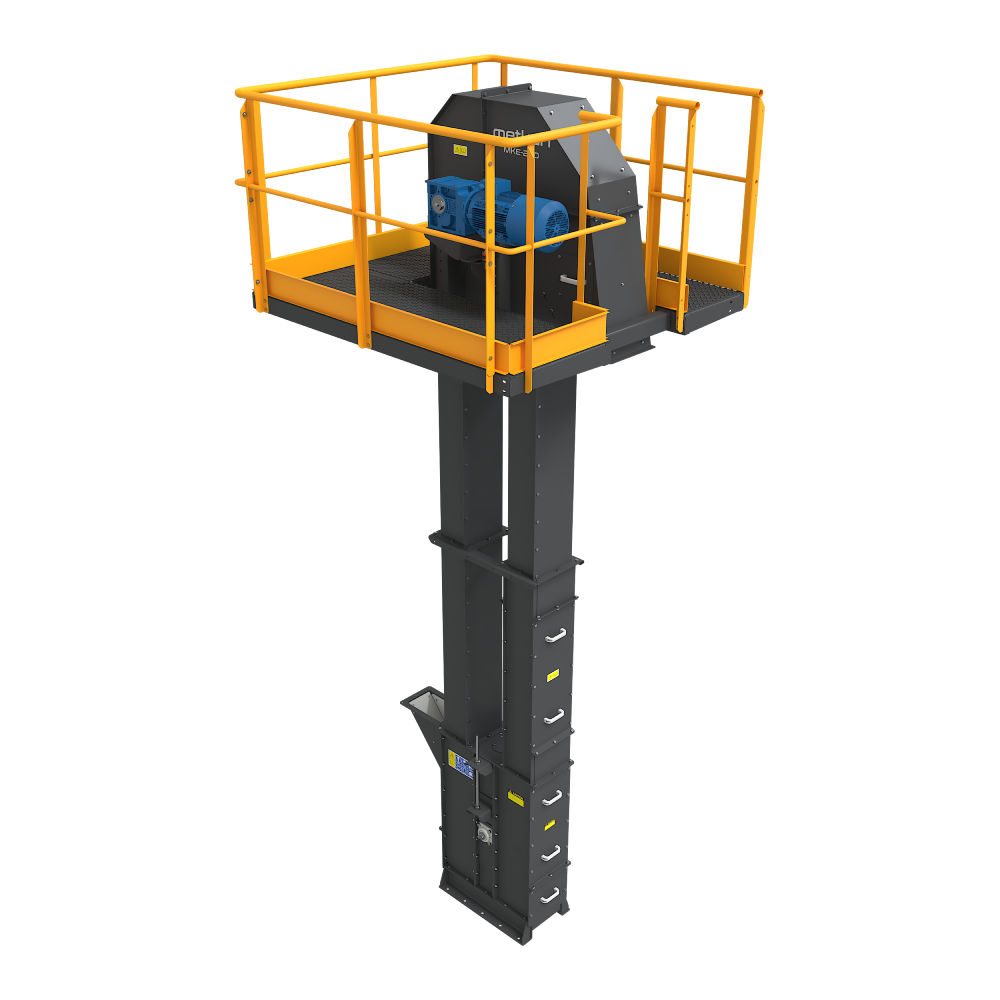
Bucket elevatorIt is a mechanical conveying system used to transport material vertically. The system operates using buckets attached at regular intervals; these buckets are fixed onto a belt or chain. The product is picked up from the bottom feed point and transported upwards, then discharged into the line in a controlled manner at the top. While this operating principle may appear simple, the system's actual performance is determined by factors such as bucket design, conveying speed, the choice of belt or chain, and the structure of the casing. Therefore, bucket elevatorit should not be viewed merely as a simple lifting solution.
Vertical conveying often becomes a necessity in production facilities, as plants do not always possess vast horizontal space. Furthermore, certain processes require silo feeding or the transfer of materials to higher elevations. In such scenarios, bucket elevator offers significant advantages. The system facilitates the installation of more processes within the same footprint and streamlines material flow. By providing controlled conveying for powdered and granular products, it serves as a robust solution, particularly for lines handling construction chemicals and similar materials. Consequently, bucket elevatoris a piece of equipment that effectively harmonizes plant layout with production efficiency.
What is the function of a bucket elevator?
The primary function of a bucket elevator is to convey material from a lower level to a higher one. However, the system's contribution extends beyond mere lifting; it ensures consistent feeding along the production line and provides greater control over material flow. It delivers a steady supply of product to equipment located at higher elevations—such as mixers, hoppers, or silos—thereby reducing sudden load spikes along the line and stabilizing the feeding rhythm. This level of order offers a major advantage, especially in facilities that operate continuously.
If the need for vertical conveying is met with the wrong system, capacity loss may occur. Product spillage can increase, and maintenance requirements rise. However, the right system bucket elevatorpreserves capacity and enhances product safety. Controlled transfer plays a crucial role, especially with fine granules, powders, and small-grained raw materials, because any disruption in material flow causes a drop in efficiency for downstream equipment. Bucket elevator Therefore, it is not merely an auxiliary system; rather, it is a primary piece of conveying equipment that supports process continuity.
How does a bucket elevator work?
Bucket elevatorIt picks up the product from the feed point at the bottom. As the buckets move, they fill with material. A belt or chain system then carries the buckets upward. At the top, the discharge point engages, transferring the material to the target line. Afterward, the buckets turn around and descend back to the lower feed area. This cycle repeats continuously, allowing the system to transport product steadily along the vertical line. While the operating principle may seem straightforward, actual performance depends on a precise technical balance.
Speed regulation is particularly critical here; excessive speed can cause the product to scatter, while low speed may limit capacity. Bucket design also influences the outcome; a suitable bucket structure ensures more controlled filling and discharging. Additionally, internal guiding structures affect conveying success. If product flow and discharge geometry are aligned, the system operates more stably. For this reason, bucket elevator the design is not based solely on height requirements; factors such as material type, capacity, and discharge characteristics are all taken into account.
In which sectors are bucket elevators used?
Bucket elevator It is used primarily in sectors requiring vertical conveying. The construction chemicals industry is at the forefront of these applications, as raw materials in these lines must be transported to silo levels, mixer inlets, or intermediate feed points. Vertical product flow is also common in mining and aggregate facilities. This system is preferred for many lines transporting granular and fine-grained materials. Furthermore, in processes such as cement production, bucket elevator it plays a significant role. This system stands out wherever consistent and controlled product transfer is required.
Technical expectations vary by sector. In construction chemicals, dust control and uniform feeding are crucial. In mining, durability and capacity take precedence. For aggregates, load characteristics and abrasion behavior are the deciding factors. Therefore, selecting a system based solely on the sector name is insufficient; factors such as particle size, density, flow characteristics, and conveying height must be evaluated together. With the right analysis, bucket elevator it ensures both efficiency and long-lasting, reliable operation.
What factors should be considered when selecting a bucket elevator?
Bucket elevator When making a selection, the material to be conveyed must first be clearly defined. Is the material fine dust, granular, fragile, or abrasive? The answers to these questions directly influence the system design, as not all products exhibit the same conveying behavior. Fragile products require gentler handling, abrasive products demand a more durable structure, and dense materials necessitate more robust conveying components. Consequently, the selection process should always begin with material analysis.
The second step involves calculating capacity and height. The hourly conveying rate and the vertical distance must be evaluated together, as height information alone is insufficient. Similarly, relying solely on the capacity value does not ensure the right choice. The third step concerns discharge characteristics. Questions such as which line the product will be transferred to at the discharge point, how steady the flow will be, and whether there is downstream equipment are all significant. The fourth factor is maintenance access, as a system that is easy to inspect results in less downtime. Therefore, technical selection should be based not only on initial installation costs but also on long-term operational considerations.
Why are capacity, bucket design, and the choice between belt and chain systems important?
Capacity bucket elevator lies at the heart of the selection process, as the entire mechanical structure is shaped by the volume of product the system is required to transport per hour. Bucket volume, the number of buckets, operating speed, and conveying elements are all determined based on this target. Insufficient capacity slows down the line, whereas an oversized system drives up investment costs. Consequently, capacity calculations must be balanced, and fluctuations in product flow must also be taken into account.
The bucket design is just as important as the capacity, as it directly influences the product's filling and discharge characteristics. An unsuitable bucket shape can lead to product loss and disrupt the flow. The choice between a belt and a chain system depends on the nature of the load; a belt system may be suitable for lighter, more controlled products, whereas a chain system is preferable for heavier loads and more demanding conditions. Therefore, the technical team must evaluate both the product type and the operating conditions. Striking the right balance ensures the system operates more efficiently and safely.
How does a bucket elevator contribute to the production line?
Bucket elevator It brings order to the production line. Instead of accumulating at the lower level, material is transported to the upper level in a controlled manner, creating a cleaner and more organized flow within the facility. Furthermore, the production line becomes more compact, reducing the need for horizontal space. It also ensures a more consistent feed to equipment operating at the upper level—a factor that makes a significant difference, particularly at feed points preceding mixers or silos.
Furthermore, bucket elevator It supports process continuity; a steady product flow minimizes downtime along the line and ensures that downstream equipment operates more consistently. This is significant not only for capacity but also for quality. Consistent feeding adds immense value, especially in lines requiring precise formulations, such as those for construction chemicals. Therefore, bucket elevatorit is not merely a conveying machine for the facility, but a key component that reinforces process discipline.
Why is the bucket elevator a strategic piece of equipment for Metkan Makine?
Metkan MakineIts product design establishes a line logic based on process integrity. Within this framework, bucket elevator it plays a strategic role by supporting the feeding process at every point requiring vertical conveyance. It also complements the production flow by operating alongside other equipment such as screw conveyors, mixers, and belt conveyors. Therefore, bucket elevatorit should be evaluated based on its specific role within the system rather than in isolation.
This approach is particularly crucial in production lines focused on construction chemicals, mining, and aggregates, as product flow in these sectors is not exclusively horizontal; vertical transfers also dictate the pace of production. Metkan Makine’The technical perspective becomes clear here: equipment selection must be aligned with the process objective. Bucket elevator When planned with the right height, capacity, and flow logic to meet this objective, it makes a significant contribution to the production line.
Frequently Asked Questions
What is a bucket elevator?
A bucket elevator is a vertical conveying system that transports material from a lower level to an upper level. Buckets are attached to a belt or chain, carrying the product upwards. The system is particularly efficient for handling powdered, granular, and small-grained raw materials.
What is the function of a bucket elevator?
The bucket elevator transports raw materials vertically in a controlled manner, ensuring a steady flow of product to silos, bunkers, mixers, or intermediate feed points. It also enables a more compact and organized production layout on-site.
In which sectors are bucket elevators used?
Construction chemicals, mining, aggregate They are frequently preferred in sectors requiring vertical conveying. They play a vital role, especially in lines that necessitate the controlled transfer of raw materials in granular or powder form.
How is the capacity of a bucket elevator determined?
Capacity calculations take into account the hourly conveying rate, conveying height, product density, and bucket volume. An accurate capacity plan ensures the system operates efficiently and minimizes the risk of over- or under-investment.
Should a belt-type or chain-type bucket elevator be chosen?
This decision depends on the product characteristics and operating conditions. A belt-type design is suitable for lighter, more controlled products, whereas a chain-type design offers a more robust solution for heavier loads and demanding operating conditions.
Why do bucket elevators offer advantages for vertical conveying?
Because the system provides efficient conveying within a limited footprint. It also ensures a steady feed to equipment located at higher elevations. Additionally, the reduced need for horizontal space offers a significant advantage regarding facility layout.
What is the most common mistake made when selecting a bucket elevator?
The most common mistake is focusing solely on height or capacity. However, factors such as material type, bucket design, conveying elements, discharge characteristics, and maintenance requirements must all be evaluated together.
What should be considered when maintaining a bucket elevator?
Bucket connections, the belt or chain structure, bearing points, and the discharge zone require regular inspection. Additionally, internal cleaning and general checks must be scheduled to prevent product buildup.
Metkan Makine ...suitable for your production line... bucket elevator ...by planning the right solution, you can create a more organized, efficient, and controlled vertical conveying system. To determine the technical system best suited to your project... contact us.