Palletizing robot price...is one of the topics most frequently researched by businesses looking to invest in end-of-line automation. This is because businesses want to see the true investment cost of the entire system, not just the price of the robotic arm. The most common mistake at this stage is evaluating the price based solely on the robot body. However, a palletizing robot only makes sense when considered alongside the robotic arm, gripper system, product feed line, conveyor structure, safety enclosure, automation infrastructure, and palletizing scenario. Therefore, a sound price analysis must be conducted based on the system as a whole, rather than focusing on a single machine in isolation. Metkan Makine ...the right investment plan is shaped not merely by the choice of equipment, but by an approach that considers the entire end-of-line workflow holistically.
Even two facilities with the same production volume Palletizing robot ...require different investments. This is because one line might handle bagged products, while another handles boxes or packages. One facility might suffice with a slower cycle time, whereas another requires a faster, continuous flow. Some projects may only need a simple layout, while others require alignment conveyors, diversion lines, and dedicated safety zones. Therefore,"What is the price of a palletizing robot?"...there is no fixed, one-line answer to this question. The correct answer emerges only when product characteristics, cycle time requirements, spatial constraints, and the level of automation are evaluated together.
Contents
- Why isn't the price of a palletizing robot stated as a single figure?
- How do the robot type and conveying capacity affect the price?
- Why does the choice of gripper system alter the investment cost?
- Why are the product type and the structure of bags or boxes important in price calculations?
- How do line speed and cycle time determine the investment in the robot?
- How do conveyors, alignment units, and infeed equipment affect the total cost?
- Why do the level of automation and safety infrastructure increase the price?
- How do the installation area and facility layout shape the investment plan?
- How can an accurate budget plan be created for a palletizing robot investment?
- Frequently Asked Questions
Why isn't the price of a palletizing robot stated as a single figure?
Palletizing robot price It is not stated as a single figure because the investment consists of more than just the robot arm. While the robot arm sits at the center of the system, it does not constitute an end-of-line automation solution on its own; the gripper system must be compatible with the product. Conveyor line transports the product flow to the robot. Alignment and orientation points ensure palletizing quality. The automation infrastructure synchronizes the entire flow, while safety barriers and peripheral equipment complete the system. Therefore, the actual price becomes clear only when all components are combined.
Furthermore, the scope of the project directly affects the price. Some businesses have only basic palletizing requirements. Some businesses operate with varying product sizes, require rapid format changes, and demand more advanced control infrastructures. While a standard gripper might suffice for one project, another might necessitate a specialized vacuum or mechanical gripper. Consequently, the robot's price is calculated based on the specific application scenario rather than a standard catalog listing. To ensure a sound investment, system parameters are defined first, followed by the budget calculation.
How do the robot type and conveying capacity affect the price?
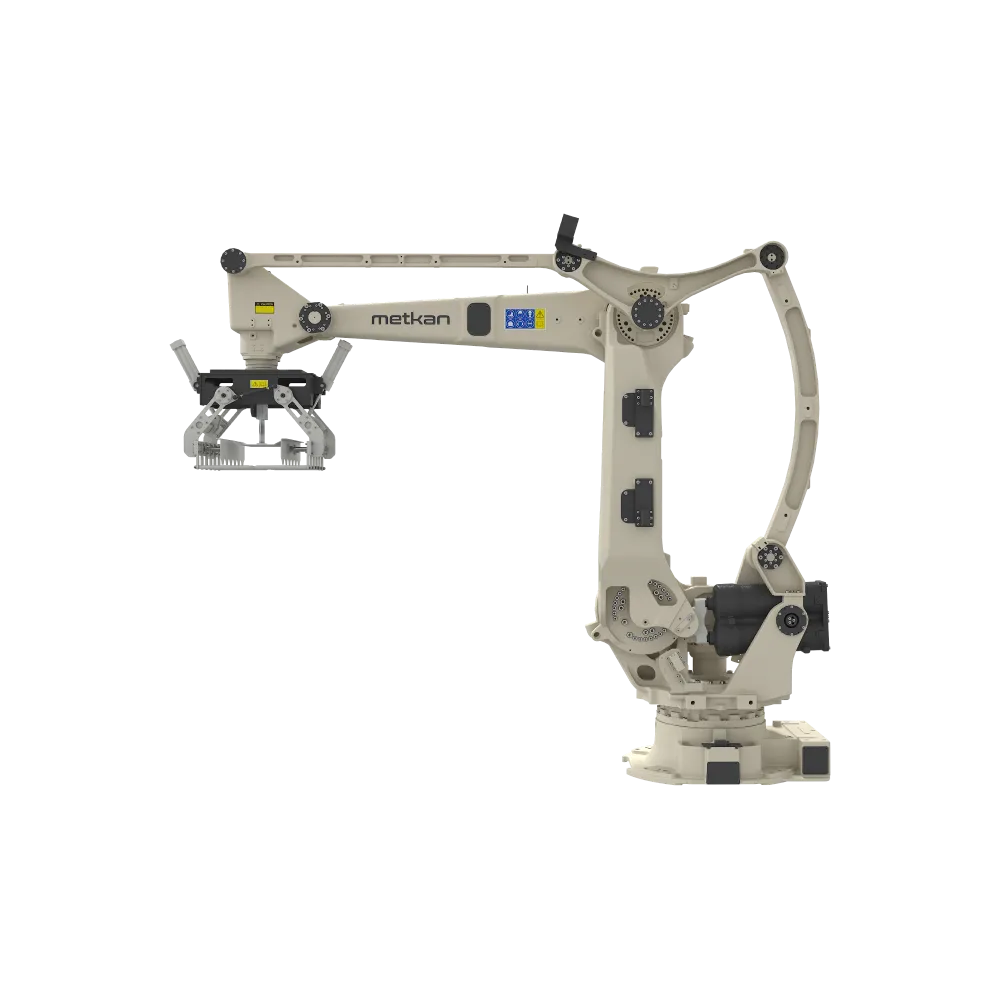
The robot type is a primary factor in determining the price, as not all robots offer the same reach, speed, and handling capacity. Different body structures are preferred for lines handling lightweight products, whereas systems dealing with heavy bags, cartons, or multi-product loads require more powerful robots. As handling capacity increases, so do the robot's mechanical power, motor specifications, and overall system cost; therefore, product weight and cycle time requirements are evaluated in tandem.
Reach is equally critical. It is not enough for the robot merely to pick up the product; it must also place it securely at the precise location on the pallet. Different classes of robots are employed for lines requiring a wide operating area, dual-pallet operation, or extended reach, all of which directly impact the investment budget. Metkan Makine Selecting the right robot means establishing a system that neither overstrains capacity nor creates bottlenecks in the production line. This approach maximizes investment efficiency while mitigating future capacity constraints.
Why does the choice of gripper system alter the investment cost?
The gripper system establishes the physical connection between the palletizing robot and the product, making it a significant component of the investment cost. This is because products such as bags, cartons, boxes, packages, or items with varying surface textures cannot all be handled by the same type of gripper. Some applications require mechanical gripping, while vacuum-based systems are preferred on certain lines. In other projects, specially designed hybrid grippers are used to preserve the product's shape. These variations directly impact costs.
A gripper system does more than just pick up products; it also influences placement precision, cycle times, and the arrangement on the pallet. Fragile products require controlled contact, while variable bag shapes demand a more balanced grip. Boxes with slippery surfaces require a different gripping approach. Consequently, selecting the right gripper is central to cost calculations. An incorrect gripper not only leads to quality issues but also reduces line efficiency, whereas the right gripper unlocks the system's true performance.
Why are the product type and the structure of bags or boxes important in price calculations?
Product type, Palletizing robot price...is one of the most critical data points determining [the system]. This is because bags and boxes do not exhibit the same conveying behavior. Similarly, rigid cartons and soft bags do not require the same stacking logic. Product dimensions, surface condition, weight distribution, and shape stability directly impact the robotic system. Therefore, when calculating the price, the product group is first clearly defined. Subsequently, the gripper system, conveyor layout, and cycle plan are determined based on this data.
For bagged products, shape variation and surface flexibility are taken into account. In carton palletizing, corner accuracy and stacking precision take precedence. In applications handling multiple products, the gripper area and cycle calculations proceed differently. Consequently, when the product type changes, the entire system approach changes—not just the end-of-arm tooling. Metkan Makine ...therefore approaches the palletizing investment from a process-based perspective rather than a product-based one. This is because the correct price emerges from the correct product scenario.
How do line speed and cycle time determine the investment in the robot?
Line speed directly determines the robot investment. This is because the robot does not merely stack products onto the pallet; it must also keep pace with the production line speed. If the line outputs a specific number of products per minute, the robot must match that same cycle safely and reliably. A simpler configuration suffices for a line requiring a slower cycle. High-speed lines, however, require a more powerful robot, a more balanced product flow, and more advanced software. This difference is directly reflected in the cost.
Cycle time is not limited solely to robot movement. The manner in which the product reaches the robot, the gripper's pick-and-place time, and the pallet exchange arrangement are also part of this calculation. If the system is to operate with dual pallets or maintain a continuous product flow, the robot's operational scenario becomes more complex. Therefore, simply asking "how many kilograms can the robot lift" is insufficient when calculating the price. Questions such as "what is the line's output rate (products per minute)" and "under what scenario does the robot handle this flow" must also be considered.
How do conveyors, alignment units, and infeed equipment affect the total cost?
Palletizing robot The price is not determined solely by the robot arm itself; the conveyor line, product alignment systems, diversion equipment, and infeed arrangement also influence the total budget. This is because the robot requires a precise infeed to function correctly. If a product arrives at the robot misaligned, the stacking pattern on the pallet will be compromised. If the flow of bags or boxes is unstable, the cycle efficiency suffers. Consequently, alignment conveyors, post-weighing conveyor lines, transfer points, and pallet infeed areas become integral parts of the system.
In some projects, a simple conveyor setup suffices. Other lines, however, require vibrating conveyors, bag alignment units, weighing conveyors, or pallet discharge lines. While these additional components increase the cost, they also safeguard the system's efficiency. Metkan MakineFor this reason, the end-of-line automation approach evaluates the robot, conveyor, and infeed line as a unified whole. No matter how powerful the robot is, consistent palletizing is impossible if the product infeed is irregular.
Why do the level of automation and safety infrastructure increase the price?
As the level of automation increases, the system operates with greater control, though the investment budget rises accordingly. This is because higher automation requires a more advanced control infrastructure, additional sensors, more robust software, and more detailed operator interfaces. Product counting, format recipes, alarm scenarios, palletizing patterns, and cycle monitoring define the scope of automation. Simpler systems offer a lower initial investment, whereas advanced systems provide greater control capabilities.
Safety infrastructure is also a significant part of the cost. Robot enclosures, light curtains, safety gates, protective fencing, and safety logic systems are indispensable components of the investment. These elements are required not only for regulatory compliance but also for sustainable operational safety. Moreover, higher safety levels reinforce operational discipline. Therefore, the cost of automation and safety should not be viewed merely as an additional expense; the correct approach is to regard this infrastructure as an investment that safeguards production continuity.
How do the installation area and facility layout shape the investment plan?
The installation area directly influences robot selection and system configuration. Factors such as the robot's safe working zone, the pallet exchange point, the product infeed line, and operator access must be considered holistically. Confined spaces require a more compact layout, whereas spacious areas allow for diverse palletizing scenarios. If the facility's structure restricts the robot's range of motion, the configuration must be redesigned; this impacts both equipment selection and total cost.
A poor layout often leads to a future need for revisions—such as changing conveyor direction, expanding the pallet area, enlarging the safety perimeter, or adding solutions for operator access. Conversely, a well-planned site layout ensures smoother system operations. Metkan Makine Therefore, end-of-line automation projects should not focus solely on the robotic arm. The primary goal is to optimize the robot's workspace in conjunction with the product flow. This approach maximizes the return on investment.
How can an accurate budget plan be created for a palletizing robot investment?
To establish an accurate budget, one must first clarify the product type, weight, target cycle time, and line layout. Subsequently, the robot type, gripper system, conveyor line, automation level, and safety perimeter are evaluated together. This ensures the investment is assessed based on the entire system rather than just the "robot price." Sound planning begins here, as any data point overlooked at the start generates additional costs as the project progresses.
Furthermore, the focus should not be limited to the initial purchase price. Operational factors—such as how the robot functions on-site, the products it handles, operator interaction with the system, and maintenance procedures—are also integral parts of the investment. Metkan Makine...’s process-oriented approach stands out here. This is because a sound palletizing investment plans not only for current needs but also for long-term production arrangements. This holistic approach both boosts line efficiency and mitigates investment risk.
Frequently Asked Questions
Why is the price of a palletizing robot not fixed?
Because not every project involves the same product type, cycle speed, and site conditions. The total investment varies depending on factors such as the robot type, gripper system, conveyor configuration, automation level, and safety enclosure.
What is the most decisive factor in the price of a palletizing robot?
Robot capacity and product type are among the most critical factors. However, the gripper system, cycle targets, and end-of-line equipment are equally important. Therefore, the price is not determined by a single factor alone.
Can a palletizing system be set up by purchasing only the robot arm?
No. While the robot arm sits at the heart of the system, it does not constitute a complete palletizing line on its own. Components such as the product infeed line, conveyor system, gripper system, automation, and safety enclosure are also required.
Can bag and case palletizing be performed using the same robot?
It may be possible in some projects; however, the product structure often necessitates changes to the gripper system and cycle logic. Therefore, investments in bag and case palletizing should be evaluated separately based on the product type.
Why is the price of the gripper system so significant?
This is because the gripper system determines the robot's contact with the product and the precision of pallet placement. An incorrect gripper leads to quality issues and lost cycle time, whereas the right gripper unlocks the system's true performance.
Does the level of automation increase the price of the palletizing robot?
Yes. Advanced software, additional sensors, recipe management, and operator interfaces increase the investment cost. However, they also enhance system control and production stability.
Is safety equipment included in the total cost?
Yes. Safety fencing, light curtains, safety gates, and control logic are fundamental components of the palletizing system. These elements play a crucial role in ensuring both safety and operational continuity.
How do you plan the right palletizing robot investment?
First, the product type, weight, cycle time, and floor layout are clearly defined. Then, the robot type, gripper system, conveyor structure, and automation level are evaluated together. A sound investment plan is established through this holistic approach.
Metkan Makine with end-of-line automation By correctly planning your investment based on product structure, cycle targets, and facility flow, you can establish a more efficient, controlled, and sustainable palletizing system. To determine the most suitable palletizing robot solutionfor your project, contact us..