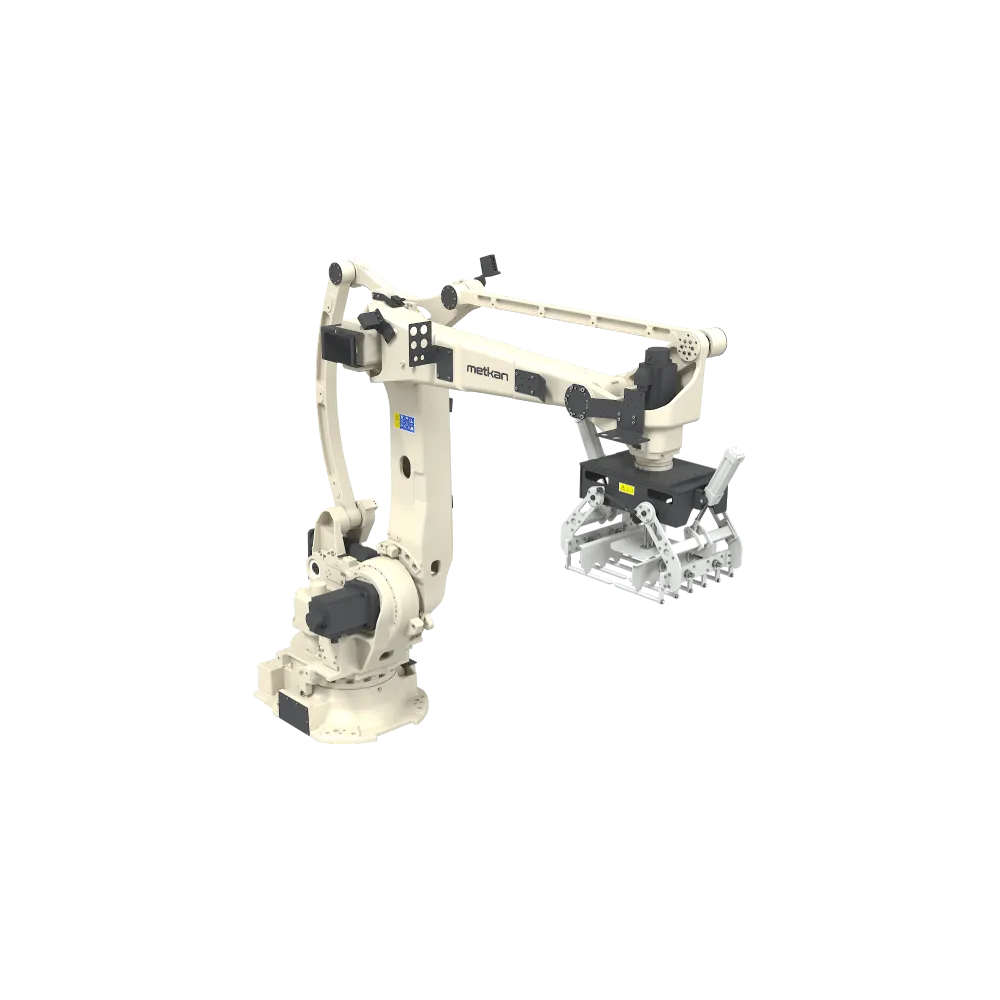
Robotic palletizing systemsensures speed and order at the final stage of the production line. These systems stack bags, boxes, and packaged products onto pallets in a consistent pattern. This allows for a more controlled end-of-line flow and speeds up shipment preparation. Such organization is particularly crucial for high-volume production facilities, as any slowdown at the end of the line impacts the entire production pace. Orderly palletizing simplifies warehouse management and enhances product safety.
Metkan Makine, Robotic palletizing develops solutions for the rapid, orderly, and safe stacking of bags, boxes, and packaged products. This approach aims not only for speed but also strengthens the integrity of the production line. Robotic palletizing system filling, conveyor, weighing It delivers higher efficiency when operating in conjunction with labeling processes. Therefore, the investment decision is not based solely robot on the robotic arm itself; the entire production line is evaluated as a whole.
Contents
- Why are robotic palletizing systems important?
- What is the function of a robotic palletizing system?
- In which sectors is robotic palletizing prominent?
- Why does robotic palletizing offer advantages over manual palletizing?
- Why is line integration important?
- Why are compact design and rapid product changeover important?
- How does the stacking pattern affect shipment safety?
- What approach does Metkan Makine emphasize in its robotic palletizing solutions?
- Frequently Asked Questions
Why are robotic palletizing systems important?
No matter how fast the production line operates, if the palletizing section lags behind, the flow is disrupted, as products begin to accumulate at the end of the line. This buildup eventually slows down the entire line. Consequently, robotic palletizing system it does not merely operate at the final stage; it also maintains the pace of the entire line. When products are placed onto the pallet at a consistent speed and in a uniform pattern, production proceeds more steadily, and operator strain is reduced.
Palletizing Its quality directly impacts shipment safety. Irregularly stacked bags can shift during conveying, causing the pallet to lose its balance and making it difficult to stack pallets on top of one another in the warehouse. In contrast, the robot system consistently applies the same pattern. This ensures the pallet layout is maintained, enhances product safety, and reduces risks during shipment. Therefore, Robotic palletizing systemsrepresents an investment not only in automation but also in quality standards.
What is the function of a robotic palletizing system?
Robotic palletizing systempicks up products arriving at the end of the line and arranges them on the pallet according to a specified pattern. This process repeats continuously, with the system maintaining the same movement and precision. Consequently, the palletizing pace remains constant, and the stacking structure stays uniform across every pallet. This offers a significant advantage, particularly for bagged products, as proper stacking improves pallet stability and makes the subsequent conveying process safer.
This system does more than just place products; it also regulates the end-of-line flow. Products move along conveyor at precise intervals. The robotic arm tracks this flow, picks up the product, and places it onto the pallet. This arrangement eliminates pace variations caused by human factors and reduces issues such as shift changes, fatigue, or repetitive errors. Ultimately, the operation achieves more predictable palletizing performance.
In which sectors is robotic palletizing prominent?
Robotic palletizing systems stands out most prominently in sectors characterized by high-volume flows of bagged, boxed, and packaged products. Construction chemicals is a prime example of such a sector, as it involves high-speed bagging operations where a stable pallet structure is critical for warehousing and shipping. Additionally, logistics centers, packaging lines, and automated storage systems make extensive use of Robotic palletizing makes extensive use of these solutions.
Regardless of the product type, the requirement remains similar. The end of the line demands order, continuous repetition, and secure stacking. Manual palletizing meets this need up to a certain point; however, as volumes increase, maintaining consistent speed and quality becomes difficult. Robotic palletizing system This is where it stands out. Whether handling bags or boxes, it stacks products in an organized manner using the same logic, thereby delivering consistent efficiency across various sectors.
Why does robotic palletizing offer advantages over manual palletizing?
Robotic palletizing systems Beyond the speed advantage, the robotic arm repeats the same movement ceaselessly without fluctuations in pace. In contrast, manual palletizing speeds vary depending on the operator, and shift intensity can also impact the outcome. The robotic system, however, maintains the same level of order throughout the day. This consistency is invaluable, particularly for high-volume production facilities.
The second major advantage is stacking consistency. The robotic arm executes the same pallet pattern every time, ensuring the product arrangement remains intact and the pallet looks neat. It also enhances safety during conveyance and reduces error rates; in manual stacking, minor shifts can accumulate over time, leading to significant instability. Robotic palletizing It prevents this issue. Consequently, the operation achieves superior performance in terms of both speed and quality.
Why is line integration important?
Robotic palletizing system It does not generate high efficiency on its own, because the success of the robotic arm depends on the preceding flow arrangement. The filling system must discharge the product at the correct speed. The conveyor line must transport the product with the correct spacing. Weighing and labeling processes must also align with this rhythm. Only under these conditions does the robotic arm operate without interruption. Otherwise, products accumulate, delays occur, and end-of-line efficiency drops.
Therefore, integration, Robotic palletizing is a fundamental part of the system. The stronger the synchronization established along the line, the more stable the robot's operation. This balance becomes particularly evident in bagged product lines, as bag arrangement, product spacing, and pick-up points directly influence the robot's movement. For this reason, Metkan Makine approaches robotic palletizing solutions not in isolation, but as part of the entire line. This approach makes the production flow more robust.
Why are compact design and rapid product changeover important?
Not every facility offers ample space. Therefore, Robotic palletizing a compact design provides a significant advantage in these systems. Systems that occupy less space integrate more easily into existing lines and do not strain the facility layout. This is especially important for businesses looking to add automation to existing operations; a compact system allows for a more efficient installation within the same footprint.
Rapid product switching is also crucial for production flexibility, as some lines switch between different bag or box sizes during the day. In such cases, the system should not require long setup times. A structure that enables quick transitions reduces production losses and simplifies operator management. Robotic palletizing system The facility operates with greater flexibility when it can rapidly adapt to varying product dimensions. This enhances the investment's utility value.
How does the stacking pattern affect shipment safety?
The stacking pattern ensures more than just visual quality; it also determines the safety of the conveying process. When bags are arranged on the pallet using the correct pattern, the load balance is maintained. Consequently, the pallet remains more stable during transport, and vertical stacking in the warehouse becomes safer. Furthermore, forklift maneuvers are executed with greater control. Ultimately, this reduces product damage during shipment.
Irregular stacking, on the other hand, has the opposite effect. Products may shift on the pallet, disrupting the center of gravity and complicating warehouse and shipping operations. A robotic palletizing system mitigates this risk by consistently applying the same pattern and placing products according to a predefined scheme. This strengthens shipment safety and increases the efficiency of logistics processes.
What approach does Metkan Makine emphasize in its robotic palletizing solutions?
Metkan Makine Robotic palletizing ...prioritizes speed, order, and integration in its solutions. This approach does not view the robotic arm in isolation; instead, it focuses on the arm's role within the entire production line. Palletizing success stems from more than just the robot's movement; product flow, conveyor layout, weight control, and end-of-line rhythm are equally critical. For this reason, Metkan Makine positions its palletizing solutions within the context of total process integrity.
Construction chemicals, mining and aggregate In such sectors, production pace requires robust planning. Robotic palletizing system ...represents the final link in this planning chain. The right system organizes end-of-line flow, maintains stacking quality, and enhances shipment safety. It also reduces reliance on operators. This is precisely where Metkan Makine’s approach stands out: establishing a more organized, faster, and more sustainable end-of-line structure.
Frequently Asked Questions
What is the function of a robotic palletizing system?
Robotic palletizing systemIt receives bags, boxes, and packaged products at the end of the line and stacks them onto pallets according to a specific pattern. This system increases palletizing speed, maintains stacking consistency, and enhances shipment security.
Why are robotic palletizing systems preferred?
Businesses choose robotic palletizing systems for their speed, organization, and consistent quality. The robotic arm repeats the same movement continuously, thereby reducing error rates and increasing production efficiency. This advantage is particularly evident in high-volume lines.
In which sectors is robotic palletizing used?
Robotic palletizing systems It is used in sectors with high volumes of bag and box handling. The construction chemicals industry is a prime example. Additionally, logistics centers, packaging lines, and automated storage systems also benefit from these solutions.
Can robotic palletizing be integrated into an existing line?
Yes, with proper planning, it can be integrated into an existing line. However, the flow of filling, conveying, weighing, and labeling must be planned in conjunction. A robust integration ensures higher system efficiency and maintains the end-of-line throughput rate.
Can a robotic palletizing system operate in a small footprint?
Systems with compact designs operate efficiently even in limited spaces. Therefore, they offer a suitable solution for businesses looking to add automation to their existing facilities. Proper spatial planning facilitates a smoother installation process.
Can the same system be used for different bag and box sizes?
Yes, with appropriate programming, the same system can handle various product sizes. Rapid product changeover is a key advantage here; the system's ability to quickly adapt to new dimensions minimizes production downtime and increases operational flexibility.
How does robotic palletizing affect shipment quality?
By creating neat and stable stacks, the system directly enhances shipment quality. Pallet stability improves, reducing the risk of shifting or toppling during conveyance. It also allows for more controlled warehouse management. Consequently, palletizing quality is a crucial component of logistics success.
What is the most critical aspect of a robotic palletizing system?
The most critical aspect is line integration. High efficiency is achieved when the robotic arm is properly synchronized with the filling and conveyor lines. If synchronization is poor, products accumulate and speed drops. Therefore, the entire line must operate at a consistent rhythm.
Metkan Makine By planning a robotic palletizing system tailored to your production line, you can create a faster, more organized, and safer end-of-line flow. For bagged and packaged products, increase palletizing efficiency, optimize workforce utilization and strengthen shipment standards contact us to contact us.