Bagging lines, Construction chemicals, cement, mining, agriculture and various dry mix production facilities, it is one of the most critical processes ensuring the product reaches the end user. However, when the problem of bag slippage arises, packaging quality declines, the palletizing pattern is disrupted, and significant product losses can occur during shipment. Therefore, bag slippage is not merely a minor mechanical issue; rather, it is a significant operational problem that directly impacts production efficiency, labor requirements, and customer satisfaction. When businesses analyze this issue at an early stage, they both maintain production continuity and make their logistics processes safer.
Metkan Makine construction chemicals facilities, bagging systems, Robotic palletizing solutions and automation aims for efficiency across all stages of the production line by evaluating these applications holistically. This is because a bagging line consists of more than just the filling machine. Conveyor systemsA high-quality packaging process emerges when weighing equipment, palletizing robots, and automation infrastructure work together. Bag slippage typically occurs due to incorrect conveyor speed, uneven filling, unsuitable bag material, palletizing incompatibility, lack of maintenance, or faulty equipment settings. In this guide, we examine in detail the technical causes of bag slippage and methods for permanent solutions.
Contents
- What is bag slippage on a bagging line?
- How does bag slippage affect the production line?
- Does uneven filling cause bag slippage?
- Why are conveyor speeds important?
- What problems arise from selecting the wrong bag?
- Why is compatibility between the palletizing system and the bagging line necessary?
- Do robotic palletizing systems reduce bag slippage?
- What problems result from a lack of maintenance and mechanical misalignments?
- How can bag slippage be prevented on the bagging line?
- Metkan Makine bagging and palletizing solutions
- Frequently Asked Questions
What is bag slippage on the bagging line?
Bag slippageis the phenomenon where filled product bags lose their intended position on the conveyor, at the palletizing point, or during stacking. This problem prevents bags from being stacked neatly and compromises pallet stability. Especially Construction chemicalsIn cement and dry-mix plants, bag shifting on high-speed production lines leads to significant operational losses. Misaligned bags require manual intervention and slow down the production flow. Furthermore, the risk of tipping during shipment increases. Therefore, businesses should not view bag shifting merely as a visual defect.
Additionally, bag shifting affects the consistency of packaging quality. Irregularly placed bags create gaps on the pallet and fail to provide the required stability, even after stretch wrapping. This situation can increase the risk of product damage, particularly during long-distance transport. Labor costs also rise when operators are constantly required to make corrections. Consequently, the mechanical and automation components of the bagging line must be evaluated holistically. Bag shifting can be largely prevented through the selection of appropriate equipment and regular maintenance.
How Does Bag Shifting Affect the Production Line?
Bag slippageIt directly reduces the overall efficiency of the production line, as irregularities in the palletizing area slow down the operating speed of robots or manual operators. When bags do not move in the correct position, the system frequently stops for corrective actions. This process lowers production capacity and complicates order scheduling. Moreover, improper bag stacking disrupts the pallet's center of gravity. Consequently, product loss and customer complaints during shipment may increase. Thus, bag shifting impacts not only the bagging section but also logistics processes.
Furthermore, an irregularly operating bagging linenegatively affects the performance of downstream equipment. A robotic palletizing system relies on bags moving forward at specific intervals and positions. If slippage occurs, the robot cannot accurately identify gripping points, causing the production flow to slow down. In facilities using manual palletizing, constant operator intervention is required. This situation increases occupational safety risks and reduces personnel efficiency. Businesses that resolve minor issues on the bagging line early on achieve higher performance across the entire production chain.
Does Uneven Filling Cause Bag Slippage?
Uneven filling is one of the primary causes of bag slippage. When the product is not distributed homogeneously within the bag, the center of gravity shifts, preventing the bag from moving steadily along the conveyor. Bags that are heavier on one side become more prone to sliding, rotating, or tipping over. This issue is particularly pronounced in high-speed bagging lines, as the combination of conveyor movement and weight imbalance disrupts the bag's position. Therefore, accurate weighing and a balanced filling system are key factors in preventing bag slippage.
Product flow at the filling spout is also of great importance. Powdered products, granular materials, and dry mixes exhibit different flow behaviors. If the filling system does not operate in accordance with these characteristics, voids or density variations may occur within the bag. Businesses should not focus solely on weighing precision. At the same time, the distribution of the product inside the bag must also be monitored. Automatic weighing and dosing systems provide greater stability at this stage. Consequently, the bags move more steadily along the conveyor and palletizing line.
Why Are Conveyor Speeds Important?
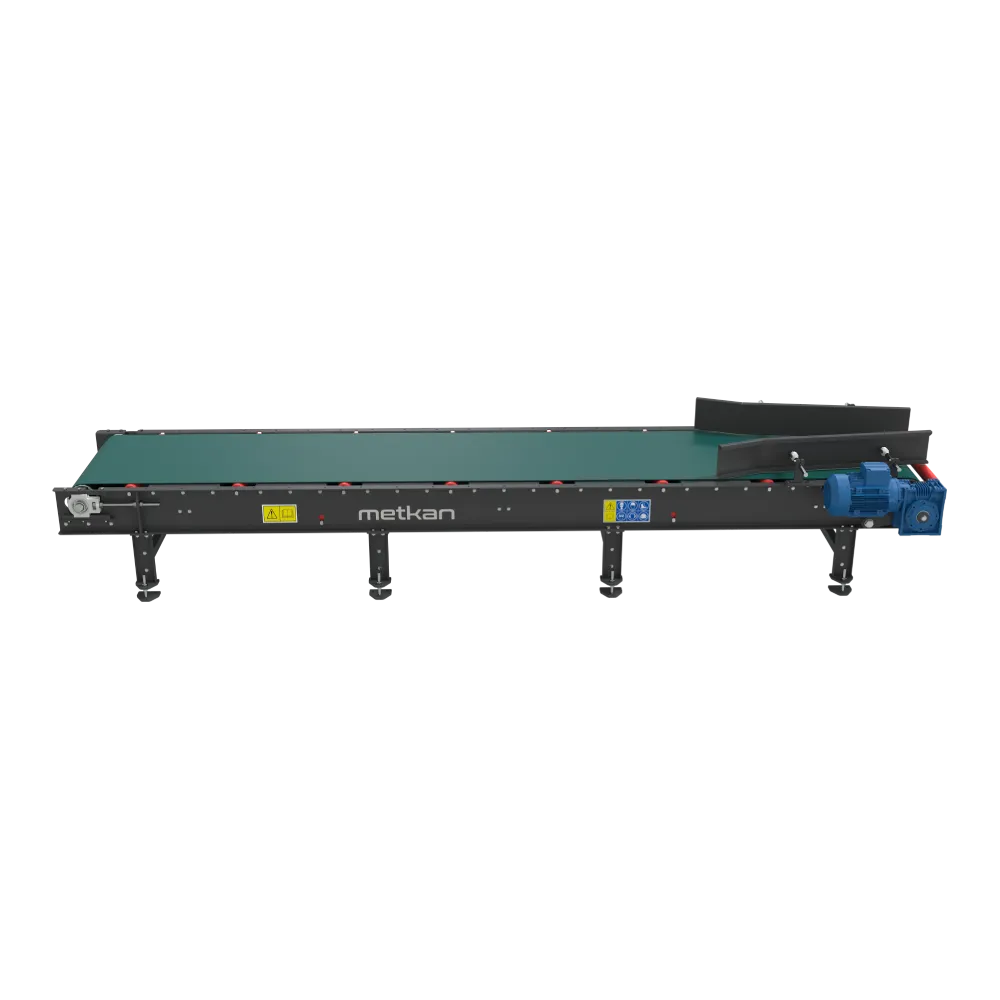
Conveyor speedis one of the critical parameters determining product flow on the bagging line. If the speed is excessively high, bags are subjected to sudden movements and begin to slide across the surface. This risk is particularly heightened for bags that have just been filled and have not yet settled into their final shape. Furthermore, if there is a speed mismatch between different conveyor sections, bags may change direction or collide with one another at transfer points. This creates significant irregularities prior to palletizing. Therefore, all conveyor systems must operate in synchronization with the production pace.
Conversely, low speeds can also lead to inefficiency. When production line capacity drops, the palletizing system is forced to wait, creating a bottleneck. The correct approach is to determine the optimal conveyor speed based on bag weight, product characteristics, and palletizing speed. Frequency-controlled systems offer significant advantages in this regard; by adjusting speeds for different products, the facility achieves more stable production. Metkan Makine, ...minimizes such problems by planning conveyor systems to be compatible with bagging and robotic palletizing solutions.
What Problems Arise from Choosing the Wrong Bag?
Bag material directly affects the performance of the bagging line. Bags with slippery surfaces shift more easily, especially on high-speed conveyors. Furthermore, bag thickness, flexibility, and surface texture determine stability on the pallet. Selecting an unsuitable bag increases the risk of slippage during stacking and fails to provide the desired structural integrity even after stretch wrapping. Therefore, businesses should not base their bag selection solely on cost; factors such as product weight, storage duration, and shipping conditions must all be considered.
Bag dimensions also influence the palletizing pattern. Non-standard sizes can cause alignment issues in robotic palletizing systems, while in manual palletizing, they require operators to make frequent adjustments. Compatibility between the bag material and the product is also crucial; unsuitable bags may deform when used with moist products or fine powders. Consequently, selecting the right bag is critical not only for packaging quality but also for production efficiency.
Why Is Compatibility Between the Bagging Line and the Palletizing System Necessary?
Palletizing system If there is no perfect alignment between the bagging line and the palletizing system, bag shifting becomes inevitable. This is because palletizing equipment operates based on specific speeds, positions, and product dimensions. When bags disrupt this order, the robot or manual operator is forced to make constant adjustments. This situation both reduces production capacity and increases labor costs. Furthermore, irregularly stacked pallets pose greater risks during shipment. Therefore, bagging and palletizing processes should be planned together.
Additionally, conveyor discharge points, the palletizing robot's reach, and the bag stacking pattern must be compatible with one another.Equipment operating at different speeds can create bottlenecks in the production flow. Businesses should not evaluate a single piece of equipment in isolation during the investment process; instead, they should plan the entire line with a unified capacity goal. Metkan Makine ensures a more balanced production flow by integrating bagging and robotic palletizing solutions.
Do Robotic Palletizing Systems Reduce Bag Shifting?
Robotic palletizing systemsYes, they significantly reduce bag shifting. This is because robots place every bag in the same position and with the same pressure. This standardized operating principle eliminates the alignment errors often seen in manual operations. Moreover, robotic systems can perform orderly stacking even at high speeds. This ensures balanced weight distribution on the pallet and enhances shipment safety. Robotic palletizing offers significant advantages, particularly for facilities manufacturing construction chemicals and those with high-tonnage output.
Furthermore, robotic systems when integrated with an automation infrastructure, production data can be tracked. Details such as when a pallet was produced and the stacking pattern used for specific products are recorded. This process also offers significant benefits for quality control. Additionally, since robots maintain consistent performance throughout a shift, capacity planning becomes more reliable. Metkan Makine Robotic palletizing its systems with the bagging line and conveyor designed to be compatible with its infrastructure, thereby supporting production continuity.
What Problems Arise from Lack of Maintenance and Mechanical Misalignments?
A lack of maintenance is a primary factor that exacerbates the problem of bag shifting over time. Wear and tear on conveyor belts, misalignment issues, or bearing problems hinder the smooth movement of bags. Furthermore, sensor misalignments can cause robotic palletizing systems to position bags incorrectly. This leads to frequent production line stoppages. By establishing a regular maintenance schedule, businesses can detect such issues early and avoid significant costs.
Mechanical misalignments also disrupt the balance of the bagging line. Differences in conveyor height, incline issues, or loose connections negatively affect bag movement. Additionally, if transition points between different pieces of equipment are not properly designed, bags may shift off course. Therefore, the maintenance team should not intervene only when a breakdown occurs; all system components must be inspected regularly through periodic checks. This ensures the bagging line operates more stably and the palletizing process proceeds smoothly.
How Can Bag Shifting Be Prevented on the Bagging Line?
The first step in preventing bag shifting is ensuring the filling system operates correctly. Weighing systems that provide balanced filling maintain the bag's center of gravity, allowing it to move more stably along the conveyor. Additionally, the bag material must be selected to suit the product's characteristics; packaging with stable surface properties should be preferred over bags that are slippery or prone to deformation. Furthermore, conveyor speeds should be optimized based on product weight. This approach prevents bags from being adversely affected by sudden movements.
Secondly, the bagging line and the palletizing system should be evaluated in conjunction with one another. Robotic palletizing solutions significantly reduce load-shifting issues by ensuring a standard stacking pattern. Furthermore, maintenance and cleaning procedures should not be overlooked; the system operates more reliably when conveyors, sensors, and mechanical connections are regularly inspected. Metkan Makine aims for maximum efficiency on the production line by approaching bagging and palletizing solutions with a focus on process integrity.
Metkan Makine Bagging and Palletizing Solutions
Construction chemicals plants —particularly in various sectors— bagging lines, Robotic palletizing systems, conveyor solutions and develops automation infrastructures. The company evaluates the entire process holistically, from the product filling stage to the point where it is ready for shipment. This approach minimizes operational problems—such as bag shifting—and enhances production continuity. Additionally, it boosts investment efficiency for businesses by offering customized solutions tailored to specific capacity requirements.
Metkan Makineviews bagging systems not merely as packaging equipment, but as the final quality control point of the production line. It establishes more organized and secure production processes through proper conveyor design, robotic palletizing integration, and automation support. If your facility is experiencing issues such as bag shifting, palletizing irregularities, or capacity loss, you can contact Metkan Makine to request engineering solutions tailored to your business.
Frequently Asked Questions
What causes bag shifting on the bagging line?
Bag shifting generally occurs due to uneven filling, incorrect conveyor speed, unsuitable bag selection, and palletizing system incompatibility. Additionally, a lack of maintenance and mechanical misalignments can exacerbate this problem.
How does uneven filling affect bag shifting?
Uneven filling alters the bag's center of gravity, causing it to move unstably on the conveyor. This can lead to the bags rotating, sliding, or tipping over.
Does a robotic palletizing system prevent bag shifting?
Yes, robotic palletizing systems significantly reduce the risk of shifting because they place each bag in the same position and with the same orientation. They also enhance shipment safety.
Why must the conveyor speed be set correctly?
If the conveyor speed is too high, bags may slip due to sudden movements. Conversely, a speed that is too low can reduce production capacity. Therefore, the speed setting must be appropriate for the product weight and the palletizing system.
What problems arise from choosing the wrong bag?
Slippery or unsuitable bags can shift out of position during stacking. Additionally, the risk of tipping and product loss during shipment increases. Selecting the right bag supports production efficiency.
Why is maintenance important for the bagging line?
Regular maintenance ensures the smooth operation of conveyors, sensors, and mechanical equipment. This reduces bag slippage, alignment issues, and unplanned downtime.
Ensure More Stable and Safe Production on Your Bagging Line
Bag slippage issues reduce production capacity, disrupt palletizing patterns, and create additional costs during shipping. You can permanently mitigate these problems through the use of the right bagging equipment, suitable conveyor systems, and robotic palletizing solutions.
Metkan Makine, bagging lines...makes your production processes more efficient through robotic palletizing systems and automation solutions. It offers engineering support tailored to your business by analyzing bag slippage and palletizing issues at your facility.
For maximum efficiency and uninterrupted production on your bagging line... Metkan Makine with contact us...let us strengthen your production line together.