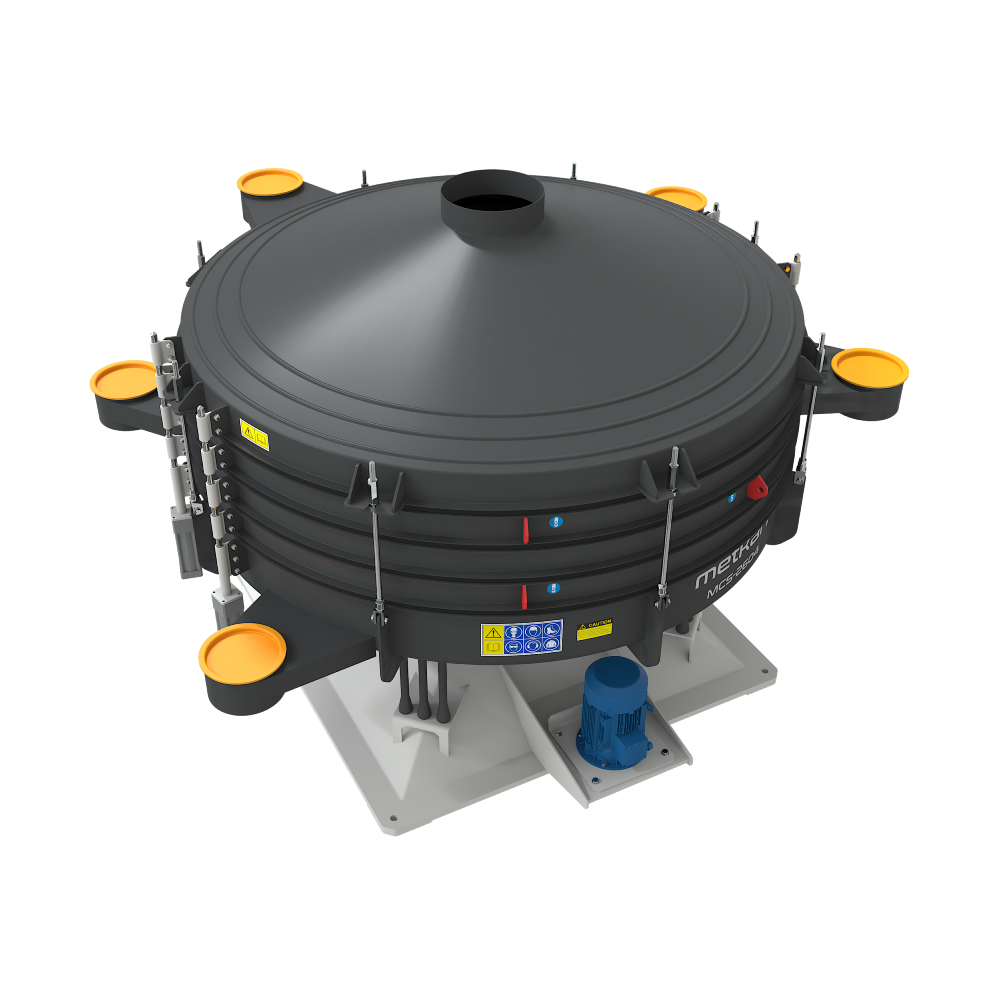
How to select a circular vibrating screen is a question crushing and screening plant operators frequently research. This is because Circular vibrating screenit is not merely a machine that separates material; it is also a key piece of equipment that directly impacts product quality, capacity balance, and line efficiency. If material discharged from the crusher is not classified correctly, product fractions mix, the circulating load increases, and the plant's overall flow is compromised. Therefore, selecting a circular vibrating screenshould not be treated as a secondary concern during the investment process. The right model, screening surface, and deck configuration ensure production stability.
One of the most common errors encountered in the field is Circular vibrating screen ...is to make the selection based solely on capacity data. However, screen performance depends on numerous variables such as material characteristics, moisture content, target product size, number of decks, vibration characteristics, and feed arrangement. The same tonnage target can yield vastly different results depending on the material type. Therefore, the selection process should not be limited to catalog data. An approach that clearly defines technical requirements, considers plant layout, and explicitly establishes product targets yields more accurate results. Metkan Makine evaluates its circular vibrating screen solutions within this technical framework and proposes the machine configuration best suited to the plant's overall structure.
Contents
- Why is selecting a circular vibrating screen a critical decision?
- What is the function of a circular vibrating screen?
- Which technical criteria should be considered when selecting a circular vibrating screen?
- How do the screen surface and the number of decks affect the selection process?
- Why are material characteristics a decisive factor in selecting a circular vibrating screen?
- Why are vibration characteristics, inclination, and feed arrangement important?
- How should plant layout and line compatibility be evaluated?
- What approach does Metkan Makine prioritize in its circular vibrating screen solutions?
- Frequently Asked Questions
Why is selecting a circular vibrating screen a critical decision?
Circular vibrating screen, Crushing and Screening is one of the main machines that determines the final product quality standard in the line. The crusher reduces the material size, while the screen defines the classification. The fractions into which the final product is separated, how it reaches the stockpile and how much material returns to the recirculation line therefore depend largely on screen performance. An incorrectly selected screen reduces overall plant efficiency. It also causes product mixing, capacity loss and irregular feeding. This situation is particularly aggregate and in mining facilities creates direct cost pressure.
Correct selecting a circular vibrating screen brings balance to the production line. Material moves correctly across the surface, classification is performed more precisely, and a more orderly flow to downstream equipment is ensured. This setup both preserves product quality and enhances operational predictability. This is also one of the most frequently asked questions by operators: "Why do two facilities operating at the same capacity yield different product qualities?" The answer often lies with the screen rather than the crusher, as the screen's dimensions, number of decks, surface type, and vibration characteristics directly determine production standards.
What is the function of a circular vibrating screen?
The circular vibrating screen separates materials of varying particle sizes using vibratory motion. When the system is in operation, material travels across the screen surface. Smaller particles pass through the appropriate apertures to the deck below or the lower discharge point, while larger particles remain on the upper deck and are collected via separate outlets. This enables the material to be sorted into desired product groups. Depending on the application, it is possible to obtain single, dual, or multiple fractions. Consequently, the circular vibrating screen plays a critical role in crushing and screening, aggregate production, and and mineral classification plays a critical role in these processes.
However, this machine does more than just separate material; it also serves as a quality control point for the facility, as the product size suitable for sale is usually finalized after the screening stage. If the production line targets specific size ranges—such as 0–5 mm, 5–12 mm, 12–19 mm, or others—this separation must be performed consistently. Circular vibrating screen performs this function. Selecting the right system ensures product standards are maintained. An incorrect choice leads to material mixing, complicates inventory management, and makes it difficult to produce goods that meet customer requirements. Therefore, the circular vibrating screen should not be viewed merely as passive intermediate equipment.
Which technical criteria should be considered when selecting a circular vibrating screen?
Circular vibrating screen The first technical criterion in the selection process is capacity. It is impossible to determine the correct model without first clarifying the hourly tonnage target. However, capacity alone does not provide sufficient data; factors such as feed size, desired output fraction ranges, and the material's flow characteristics must also be evaluated simultaneously. For instance, two different plants targeting a capacity of 100 t/h may require vastly different screening surface areas. This variation is due to differences in material density, particle size distribution, and moisture content. Therefore, the technical selection process is not based solely on the question, "How many tons need to be produced?"
The second criterion is the screen dimensions. The width and length of the screen determine its surface area. If the surface area is insufficient, the material does not spread evenly across the screen, resulting in reduced classification efficiency and an inability to clearly separate coarse and fine materials. The third criterion is the number of decks. Single-deck circular vibrating screens are used in simpler processes, whereas double- and triple-deck systems are preferred for lines requiring the separation of multiple product sizes. The key here is not to use as many decks as possible, but rather to use only as many as are necessary; systems that are unnecessarily complex increase investment costs and maintenance requirements.
The fourth criterion concerns the motor and vibration mechanism. If the vibration force is insufficient, the material will not move correctly across the surface. Conversely, excessively aggressive vibration can accelerate wear and lead to a loss of control over fine materials. Therefore, the vibration characteristics must be compatible with the specific material type. The fifth criterion is maintenance accessibility. Factors such as the ease of replacing the screen surface, the location of maintenance hatches, and the availability of service space are crucial for long-term operational performance. Metkan Makine...prioritizes not only capacity but also technical aspects such as operational continuity and maintenance accessibility in circular vibrating screen solutions.
How do the screen surface and the number of decks affect the selection process?
The screen surface is the primary working area where classification takes place; therefore, selecting the right surface type is central to the process. As the surface area increases, material spreads more evenly and moves across the screen in a more controlled manner. This offers an advantage, particularly in precise fraction separation. Conversely, if the surface area is insufficient, material piles up, separation efficiency drops, and the contamination rate rises. Thus, when selecting a circular vibrating screen, attention must be paid to the active surface area, not just the motor power.
Options regarding the screen surface—such as wire mesh, panels, or various modular structures—also impact performance. Fine material, coarse aggregatematerial, moist products, or abrasive minerals do not behave the same way on the surface. An incorrect surface choice leads to clogging and shortens the panel's lifespan. This is one of the technical issues facilities are most curious about: “Why does the screen clog frequently?” Often, the problem lies not just with the material itself, but with the surface type being unsuitable for the application. Therefore, surface selection is a technical parameter just as critical as capacity and product size.
The number of decks determines product variety. Single-deck systems suffice for a primary separation line. Double-deck systems are more suitable for lines requiring two or three product outputs. Triple-deck Circular vibrating screen structures are preferred in facilities requiring more detailed classification. However, increasing the number of decks does not merely increase product variety; ...at the same time, the structure becomes more complex. Therefore, actual requirements must be the primary consideration during selection. Metkan Makine...evaluates the deck structure in alignment with the plant's production targets and product strategy when selecting a circular vibrating screen.
Why are material characteristics a decisive factor in selecting a circular vibrating screen?
Material characteristics directly affect the performance of a circular vibrating screen. Dry, free-flowing material moves more easily across the screen, whereas moist, sticky material complicates surface behavior. Fine material forms different layers, while coarse, angular material moves differently. Consequently, the same screen model will not yield identical efficiency for two different types of material. Factors such as hardness, moisture content, particle shape, and friability must be taken into account during the technical selection process; otherwise, the values listed in the catalog will not be achieved in actual field operation.
The risk of clogging increases, particularly in plants handling moist material. Material buildup on the screen surface reduces separation quality; the fine fraction fails to pass to the lower deck, resulting in mixing with the coarse material. Similarly, feed with a highly irregular particle size distribution reduces efficiency, as the material does not move homogeneously across the surface. Therefore, when selecting a circular vibrating screen, one must analyze not only the target product size but also the characteristics of the feed material. Metkan Makine...prioritizes solutions tailored to the plant's actual operating conditions by adopting an approach that accounts for performance variations linked to material structure.
Aggregate...basalt, limestone, riverbed material, and various mineral types exhibit distinct behaviors. The same applies to recycled materials. Consequently, a "one-size-fits-all" approach does not yield reliable results for circular vibrating screens. Technical success depends on matching the right machine with the right material. When this match is achieved, capacity flow becomes more stable, screen surface lifespan extends, and maintenance requirements become more predictable.
Why are vibration characteristics, inclination, and feed arrangement important?
It is not just the machine body but also the operating characteristics that determine the performance of a circular vibrating screen. Vibration amplitude and rotational speed define how the material moves across the surface. Insufficient vibration prevents the material from spreading, leading to poor classification. Conversely, excessive vibration causes the material to pass through too quickly without effectively utilizing the screen surface. Therefore, vibration characteristics must align with the material type and the desired product outcome.
The inclination angle is equally important. An excessive angle causes the material to flow too rapidly, thereby reducing the retention time on the screen. Conversely, insufficient slope can slow down the flow and cause material to accumulate on the surface. Both scenarios negatively impact separation efficiency. Therefore, the selection process should not merely ask, "Is the machine powerful?" It must also provide a clear answer to the question, "How effectively does the material move across this surface?"
The feeding arrangement is another technical aspect that is frequently investigated yet often overlooked. If material enters the circular screen heavily and irregularly from one side, the surface balance is disrupted, leading to uneven material distribution. Consequently, the screening area cannot be utilized to its full potential. Balanced and controlled feeding enables the screen to operate closer to its true capacity. In its circular vibrating screen applications, Metkan Makine prioritizes not only the main machine itself but also the feeding arrangement and line flow, as efficient classification relies on equipment compatibility.
How should plant layout and line compatibility be evaluated?
Even if the right circular vibrating screen is selected, you will not achieve the expected performance if it is not compatible with the production line. Therefore, plant layout is a crucial part of the selection process. Factors such as inlet height, discharge directions, conveyor connections, maintenance space, and service access must be carefully planned. Cramped layouts make maintenance difficult, while incorrect discharge directions create confusion in the stockpiling area. Thus, one must evaluate not only the machine's technical capacity but also its positioning on-site.
Line compatibility becomes particularly critical in the relationship between the crusher and the screen. If the material flow rate from the crusher exceeds the screen's capacity, the system becomes overburdened. Conversely, selecting a screen with excessive capacity drives up investment costs. A proper balance must be struck between these two extremes. Additionally, whether the facility plans to increase capacity in the future also influences the selection decision. A system that appears adequate for today’s needs may prove insufficient for growing production targets. Therefore, Circular vibrating screen the investment should be viewed through a process-oriented lens rather than a short-term one.
Metkan Makine approaches its circular vibrating screen solutions within the context of the facility's overall layout. This approach strengthens not only machine selection but also long-term operational performance. Proper positioning facilitates ease of service while maintaining line compatibility and product balance. Meanwhile, accurate capacity matching improves energy and time management. This tripartite structure plays a decisive role in overall facility efficiency.
What approach does Metkan Makine prioritize in its circular vibrating screen solutions?
Metkan Makine Construction chemicals, mining and aggregate ...prioritizes technical compatibility in machinery and line solutions tailored to the relevant sectors. The same approach applies to circular vibrating screens. Selections made without simultaneously evaluating capacity targets, material characteristics, product size requirements, and plant flow result in on-site efficiency losses. Therefore, defining the correct usage scenario is just as important as selecting the right model.
In corporate projects, selecting a circular vibrating screen is not merely a purchasing decision; it is also a decision regarding quality standards, maintenance planning, and line efficiency. Metkan Makine emphasizes prioritizing configurations that align with technical requirements during this decision-making process. A more stable and sustainable production structure emerges when factors such as screen surface, deck configuration, feed arrangement, and plant layout are considered holistically. This approach becomes even more critical in multi-product crushing and screening lines.
Circular vibrating screen For businesses planning such an investment, the right technical framework offers significant advantages in terms of product quality, continuity, and capacity balance. Metkan Makine This is also where the solution philosophy—aligned with the brand's digital identity—becomes clear: a process-oriented approach rather than a machine-oriented one. This approach supports the positioning of the right equipment on the right line and makes the investment decision more secure.
Frequently Asked Questions
How is a circular vibrating screen selected?
A circular vibrating screen should be selected based on capacity targets, material characteristics, desired product size, the required number of decks, and line layout. A selection based solely on tonnage data does not yield reliable results. Technical compatibility forms the foundation of the selection process.
What factors have the greatest impact on circular vibrating screen capacity?
Capacity is influenced by the material's particle size distribution, moisture content, feed pattern, screen area, and vibration characteristics. The same model may yield different results with different materials; therefore, site conditions must be taken into account.
Should a single-deck or multi-deck circular vibrating screen be chosen?
This decision depends on the number of products desired. Single-deck systems are suitable for simpler separation tasks. If multiple product fractions are targeted, a two- or three-deck configuration yields better results.
Why do circular vibrating screens get clogged?
Primary causes of clogging include moist material, incorrect screen surface type, irregular feeding, and unsuitable aperture geometry. Clogging issues often stem not just from the material itself, but from incorrect technical specifications.
Why is the compatibility between the crusher and the circular vibrating screen important?
The flow rate and material characteristics exiting the crusher directly affect the screen's performance. An imbalance between these two pieces of equipment compromises product separation, increases the recirculation rate, and reduces line efficiency.
Why should ease of maintenance be considered when selecting a circular vibrating screen?
In systems with poor maintenance access, screen surface replacement and servicing operations result in lost time. This negatively impacts production continuity. Ease of maintenance should be included among the technical criteria for long-term operational performance.
Does the choice of circular vibrating screen change when handling moist material?
Yes, it does. Moist material moves less easily across the surface and poses a risk of clogging. Therefore, the surface type, area size, and vibration characteristics must be determined with greater care.
What is the most common mistake made when investing in a circular vibrating screen?
The most common mistake is basing the selection decision solely on capacity. However, to make the right decision, factors such as material characteristics, product targets, plant layout, and maintenance requirements must be evaluated together.
Metkan Makine When planning an investment in a circular vibrating screen, capacity, surface structure, product targets, and line compatibility must be considered together. A technical configuration suited to the project enhances production quality and supports operational continuity. To establish a more accurate technical framework for selecting a circular vibrating screen... Contact Us