Bucket Elevator Capacity Calculation
Bucket elevators play a crucial role in the vertical transport of bulk materials. Selecting the right system is particularly important for production lines requiring high capacity. However, simply looking at the elevator height or motor power does not yield accurate results. Bucket elevator capacity calculationrequires the simultaneous evaluation of many technical parameters.
Material density, bucket volume, and bucket spacing directly affect capacity. Belt or chain speed also influences the outcome, while the fill rate and discharge characteristics determine the actual operating capacity. Consequently, a discrepancy may arise between theoretical capacity and actual line capacity.
At Metkan, we approach bucket elevator solutions by considering the entire process. We evaluate the material to be transported, the target capacity, and the line configuration together. In doing so, we create a system that works in harmony with the production line, rather than just a piece of equipment that lifts material. In this guide, Bucket elevator capacity calculation we will examine in detail the principles behind bucket elevator capacity and the factors that influence it.
Contents
- What does bucket elevator capacity mean?
- What data is required for capacity calculation?
- How does material density affect capacity?
- Why are bucket volume and fill rate important?
- How does bucket spacing alter capacity?
- How does elevator speed affect capacity?
- How is bucket elevator capacity calculated?
- What is the difference between theoretical and actual capacity?
- Does elevator height affect capacity?
- How is motor power assessed?
- Why is the feeding system important?
- What problems arise from incorrect capacity calculations?
- How is the safety margin determined when selecting capacity?
- What factors should be considered when selecting a bucket elevator?
- Frequently Asked Questions
What Does Bucket Elevator Capacity Mean?
Bucket elevator capacityrefers to the amount of material the system conveys within a specific timeframe. Businesses usually evaluate capacity in terms of t/h (tonnes per hour) or cubic meters per hour (m³/h) However, these two values do not convey the same information. Volumetric capacity indicates the volume of the material, whereas mass capacity indicates the weight of the material.
For instance, the same elevator might achieve different t/h values for two different products because the products have different bulk densities. Even if a lightweight powdered product and a dense mineral fill the same bucket, they result in different weights. Therefore, considering only the number of buckets is insufficient for capacity calculations. Furthermore, the actual capacity required by the process serves as the starting point. If the line processes 20 tons of product per hour, the elevator must be able to convey this flow without interruption. Additionally, the design must accommodate short-term fluctuations in capacity.
What Data Is Required for Capacity Calculation?
To perform an accurate bucket elevator capacity calculation, one must first gather process data. This is because capacity is not determined by a single equipment parameter; rather, the material and the mechanical system work together to produce the result.
The following data are important for the basic calculation:
- Material bulk density
- Target capacity (t/h)
- Bucket volume
- Bucket fill rate
- Spacing between buckets
- Belt or chain speed
- Total height of the elevator
- Feeding method
- Discharge characteristics
- Material particle size
- Material flow characteristics
- Moisture and tendency to stick
It is essential to first evaluate the material's properties under actual operating conditions. For instance, the flow behavior of a product that absorbs moisture may change. Consequently, the bucket fill rate could decrease. Therefore, the theoretical capacity calculated on paper may not be reflected in actual production.
How Does Material Density Affect Capacity?
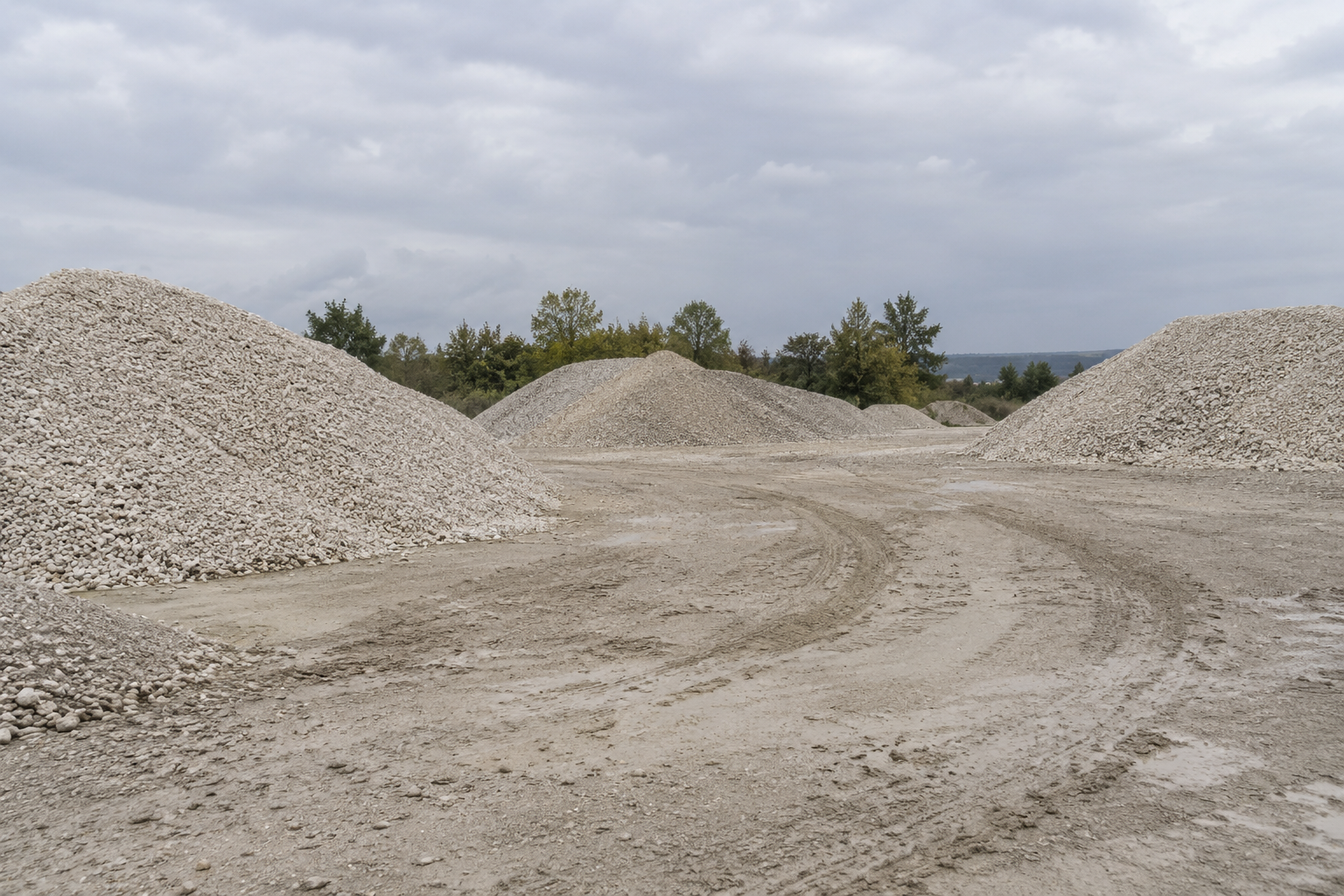
Bulk density indicates the weight of a specific volume of bulk material. Units such as kg/m³ or t/m³ are commonly used. This value plays a critical role, especially when converting volumetric capacity into t/h capacity.
Let’s proceed with a simple example. Suppose the elevator conveys 30 m³ of material per hour. Let the product's bulk density be 0.8 t/m³. In this case, the approximate mass capacity is calculated as follows:
30 m³/h × 0.8 t/m³ = 24 t/h
The result changes when the same elevator conveys a different product with a density of 1.2 t/m³:
30 m³/h × 1.2 t/m³ = 36 t/h
Consequently, the same mechanical system yields different tonnage values for different materials. Therefore, at Metkan, we place material properties at the core of our capacity assessments.
Why Are Bucket Volume and Fill Rate Important?
Bucket volume...determine the amount of material the system can theoretically transport in each conveying cycle. A larger bucket offers greater volume. However, a larger bucket does not necessarily equate to higher actual capacity under all conditions. This is where the fill rate comes into play. For instance, if a 10-liter bucket is only 70% full during operation, the effective volume is 7 liters. Therefore, calculations should use the effective volume—suited to operating conditions—rather than the nominal volume.
Material flowability also affects the fill rate. Free-flowing granular products can fill the bucket more consistently, whereas sticky or moist products may result in uneven filling. Additionally, product distribution at the inlet affects bucket filling. Thus, simply choosing a larger bucket is not the right approach to increasing capacity. The system; Bucket geometry must work in conjunction with feed conditions and product characteristics.
How Does Bucket Spacing Affect Capacity?
Bucket spacing refers to the distance between consecutive buckets on the belt or chain. A shorter spacing allows for a greater number of buckets to perform the conveying task within a given timeframe. Consequently, the theoretical capacity increases. However, reducing bucket spacing indiscriminately is not advisable. An overly dense arrangement can negatively affect material loading behavior. Furthermore, product interaction between buckets may occur during discharge. System geometry also imposes limits on the minimum bucket spacing. Therefore, the designer evaluates bucket volume and bucket spacing in conjunction. The goal is not merely to maximize the number of buckets; the primary objective is to ensure a stable and continuous product flow.
How Does Elevator Speed Affect Capacity?
Belt or chain speed determines the number of buckets reaching the discharge point per unit of time. Thus, as speed increases, the theoretical conveying capacity also rises. However, this relationship holds true only within specific operating limits. Excessive speed can prevent buckets from filling adequately. It can also alter discharge characteristics; if the product is not directed toward the discharge outlet, back-spillage may increase. In such a scenario, the actual capacity drops, even if the system is operating at high speed.
Conversely, low speed may fail to meet the target flow rate. Therefore, the optimum speed varies depending on material properties, bucket geometry, and the discharge method. Metkan evaluates these variables alongside process requirements during system design.
How Is Bucket Elevator Capacity Calculated?
The basic capacity calculation begins with determining the volumetric flow rate. To determine this, bucket volume, effective fill rate, bucket spacing, and conveying speed are used together.
The simplified approach is based on the following logic:
Volumetric capacity = Effective bucket volume × Number of buckets passing per unit of time
Effective bucket volume can be considered as follows:
Effective bucket volume = Nominal bucket volume × Fill rate
Then, we multiply the volumetric capacity by the material's bulk density:
Mass capacity = Volumetric capacity × Bulk density
For example, let's assume each bucket effectively carries 0.01 m³ of material. Let the system deliver 50 buckets to the discharge point per minute.
0.01 × 50 = 0.5 m³/minute
Hourly volumetric capacity:
0.5 × 60 = 30 m³/hour
If the material density is 1.2 t/m³:
30 × 1.2 = 36 t/h
This calculation offers a theoretical approach. In an actual project, the feeding pattern, losses, and product behavior alter the result.
What Is the Difference Between Theoretical and Actual Capacity?
Theoretical capacity is based on ideal conditions. However, production facilities do not operate under ideal conditions at all times. Material flow rates may fluctuate, the product may absorb moisture, or the feed supply may become irregular. Furthermore, buckets may not fill to the same level during every cycle. Actual capacity takes these variables into account. Therefore, using the theoretical value directly as the final capacity during the design phase poses a risk. The engineering approach must also factor in actual operating conditions.
For instance, even if calculations indicate a theoretical capacity of 40 t/h, the process might not deliver a continuous output of 40 t/h. If the feeding unit supplies the product irregularly, the elevator's average conveying rate decreases. Consequently, capacity calculations must encompass the entire line.
Does Elevator Height Affect Capacity?
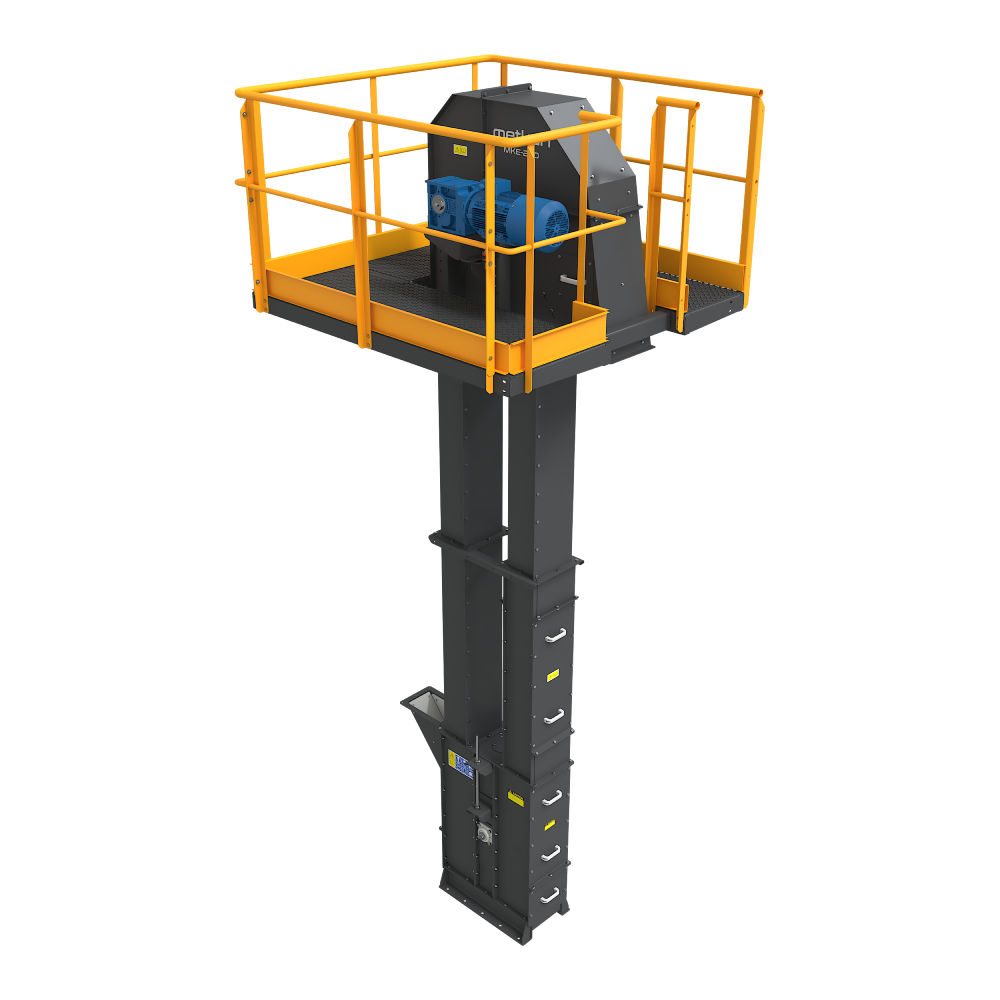
Elevator heightdoes not determine capacity as directly as bucket volume does. Nevertheless, the mechanical effects of height on the system are significant. As height increases, the system conveys a larger volume of material vertically at any given time. This increases the load on the belt or chain and influences motor and gearbox requirements. Structural stability and maintenance access also become more critical. Therefore, mechanical design plays a pivotal role in high-capacity and tall elevator systems.
Furthermore, the cost of unplanned downtime increases in high-capacity systems. Therefore, selecting the right components is just as important as capacity itself. At Metkan, we consider conveying height, capacity, and mechanical loads within a unified engineering assessment.
How is Motor Power Evaluated?
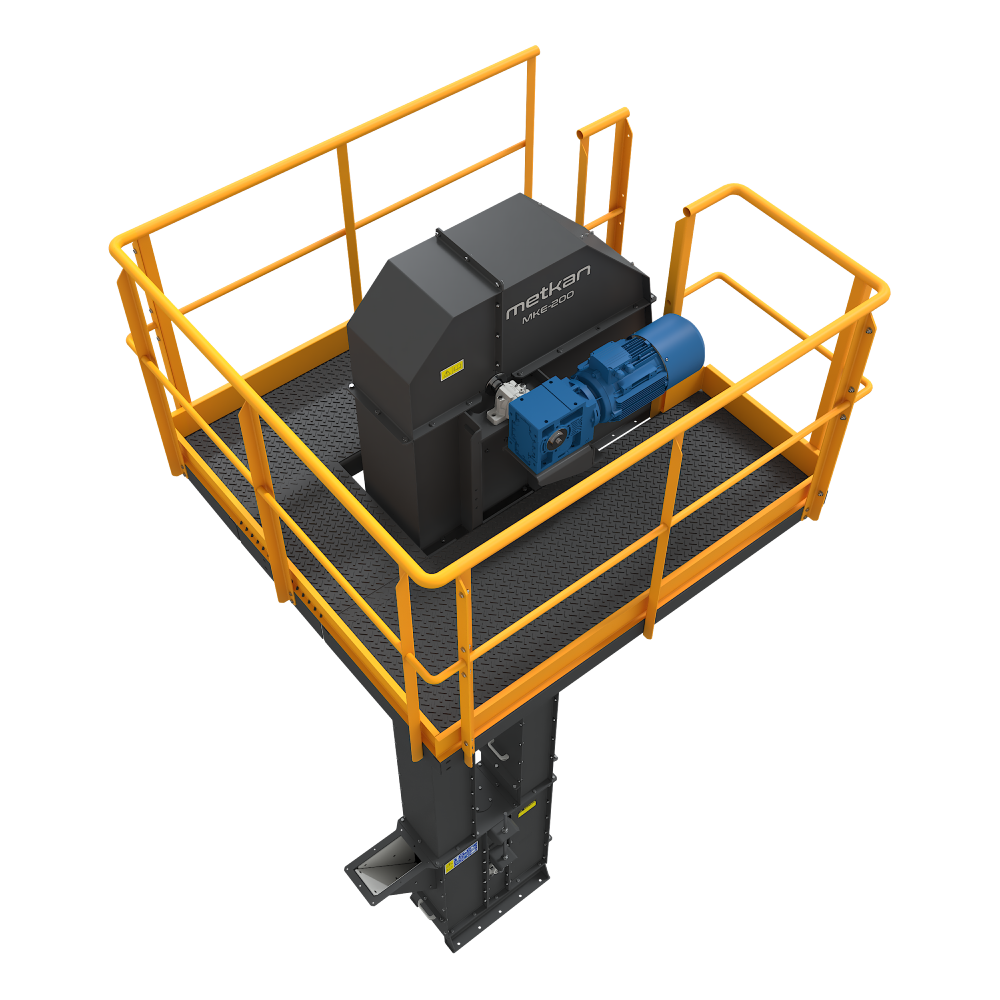
Motor power It cannot be considered in isolation from the capacity calculation, as the motor provides the mechanical energy required to transport material to a specific height. Power requirements increase as the conveyed mass and elevator height rise. However, selecting a motor based solely on the t/h (tonnes per hour) value is incorrect; mechanical losses, the weight of moving equipment, and start-up conditions are also significant factors. Additionally, gearbox efficiency and operating conditions influence motor selection.
Insufficient motor power can lead to overload issues. Conversely, an oversized motor does not always offer an advantage. The correct choice aims for a balance between power and safety that meets process requirements.
Why is the Feeding System Important?
Bucket elevator Target capacity can only be maintained with consistent feeding. Therefore, the equipment upstream of the elevator directly impacts capacity performance. If the feeding system delivers product irregularly, the buckets fill at varying rates; some may carry insufficient product while others become overloaded. Consequently, the system loses stability. Sudden load spikes can also strain the drive system. For this reason, dosing equipment, bunker outlets, or feed conveyors must operate in harmony with the elevator. The automation system must also keep flow rate fluctuations under control, ensuring a more balanced product flow along the line.
What Problems Arise from Incorrect Capacity Calculation?
An elevator with insufficient capacity creates a bottleneck in the production line. When upstream equipment delivers a higher volume of product, the elevator cannot handle the flow rate. Consequently, the risk of product accumulation and jamming increases.
An incorrect selection can lead to the following issues:
- Product spillage/fallback
- Overloading of buckets
- High tension on the belt or chain
- Increased motor load
- Clogging/blockage
- Loss of capacity
- Unplanned downtime
- Increased maintenance requirements
- Increased energy consumption
- Bottleneck in the production line
Selecting an excessively large system can also reduce investment efficiency. Furthermore, the equipment may require more space and energy. Therefore, the goal is not to choose the largest elevator, but to determine the capacity that best suits the process.
How is the Safety Margin Determined for Capacity Selection?
Flow rates in production lines do not always remain constant. Feeding equipment can generate short-term peak values. Additionally, product density or moisture content may fluctuate. For this reason, elevator design requires a capacity margin that accounts for these operating conditions. However, a high safety margin does not always equate to a better solution. Excessively high capacity results in larger equipment, more powerful drives, and higher investment costs.
Therefore, the safety margin should be determined based on the nature of the process. A line with continuous, controlled feeding does not require the same approach as a line with variable flow rates. Analyzing the actual production profile first yields the most accurate result.
What Should Be Considered When Selecting a Bucket Elevator?
Capacity is a significant criterion, but it is not the only one. The physical properties of the material directly influence the equipment configuration; abrasive products and fine powders do not require the same design approach. Furthermore, the choice between belt and chain systems depends on operating conditions. Conveying height, temperature, product characteristics, and maintenance requirements all influence this decision. The bucket type and discharge method also determine system performance.
Metkan as bucket elevator In our projects, we do not evaluate the equipment in isolation. First, we analyze the process flow of the production line. Then, we examine the material characteristics and the target capacity. In doing so, we aim to ensure the system operates in balance with the other equipment.
What Can Be Done to Increase Capacity in a Bucket Elevator?
Capacity requirements for an existing elevator may increase over time. However, simply increasing motor power or operating speed is not the right solution. First, it is necessary to determine where the existing system reaches its limits. If the bucket fill rate is low, improving the feeding arrangement yields significant gains. Incorrect bucket geometry also limits capacity. Belt speed, bucket spacing, and discharge conditions must also be checked.
Furthermore, it is essential to evaluate whether the mechanical system can handle the new load. The design of the belt, chain, bearings, gearbox, and casing must be suitable for the new operating conditions. This ensures that the capacity increase does not compromise system reliability.
How Does Automation Contribute to Capacity Control?
Automationhelps continuously monitor the elevator's operating conditions. Data such as motor current, speed, and product level provide the operator with vital information. This allows the team to detect the risk of overloading early. Additionally, proper synchronization can be established between upstream and downstream equipment. For example, when the elevator load rises, the feeding equipment can reduce the flow rate, thereby balancing the system before it reaches critical levels.
This approach offers significant advantages, particularly in high-capacity process lines, because the sustainability of capacity is just as important as the mechanical capacity itself. Controlled product flow reduces the risk of unplanned downtime.
How Does Metkan Address Capacity in Bucket Elevator Solutions?
At Metkan, we do not approach capacity calculations solely based on the t/h value. In the initial stage, we examine the product's physical properties and process conditions. Subsequently, we evaluate the conveying height, target flow rate, and line layout. We determine the bucket geometry, conveying system, and drive configuration based on this data. We also assess the operational dynamics of the feeding and discharge points, as a robust elevator cannot maintain target performance under unstable feeding conditions.
Our goal is to create a system that accurately meets the production line's requirements. This approach supports capacity continuity while ensuring more balanced operation in terms of energy consumption, maintenance needs, and equipment lifespan.
Frequently Asked Questions
In which units is bucket elevator capacity calculated?
Facilities generally express capacity in t/h or m³/h. The volumetric value indicates the space occupied by the product, whereas the t/h value accounts for product density. Therefore, knowing the material's bulk density is essential.
Does capacity always increase as bucket size increases?
Bucket volume affects capacity but does not determine the outcome on its own; fill rate, bucket spacing, and speed also influence performance. Additionally, large buckets can increase mechanical load. Consequently, all parameters must be evaluated together.
Does increasing the belt speed raise the elevator's capacity?
Increasing speed within certain limits raises capacity; however, excessive speed can disrupt bucket filling and discharge. Additionally, product back-spillage increases. Therefore, it is necessary to determine the optimum operating speed for the system.
Why is material density important when calculating capacity?
Bulk density converts volumetric capacity into tonnage. The same bucket volume carries different weights depending on the product. Consequently, the actual capacity in t/h may change when the product changes.
Is a more powerful motor required when the elevator height increases?
Generally, the power requirement increases as the conveying height rises, because the system transports the material over a longer vertical distance. However, the total load and mechanical losses also influence the outcome. Therefore, motor calculations must be based on specific project data.
What is the most common cause of capacity loss in a bucket elevator?
Irregular feeding is a major cause of capacity loss. Additionally, low bucket fill rates and incorrect speed selection reduce performance. Back-spillage and mechanical issues also limit capacity. Regular inspections facilitate the early detection of these problems.
Can the bucket elevator capacity be increased later?
Capacity optimization is possible in some systems. However, mechanical limits must be analyzed first. The bucket structure, drive system, and conveying elements must be capable of handling the new load. Therefore, any capacity increase requires planning based on an engineering assessment.
Is the t/h figure alone sufficient for selecting a bucket elevator?
No. t/h is merely one of the initial data points. Material density, particle structure, moisture content, conveying height, and the feeding method are also significant. Selecting the right system involves evaluating all process conditions holistically.
Contact Metkan for Your Bucket Elevator Project
An accurate capacity calculation ensures the bucket elevator operates in balance with the production line. At Metkan, We evaluate all process data—from material properties and conveying height to target capacity and line layout—in conjunction with one another.
If you are planning an investment in a new bucket elevator or wish to optimize the capacity of your existing line... Metkan with contact us...let us plan the conveying system that meets your needs using an engineering-driven approach.