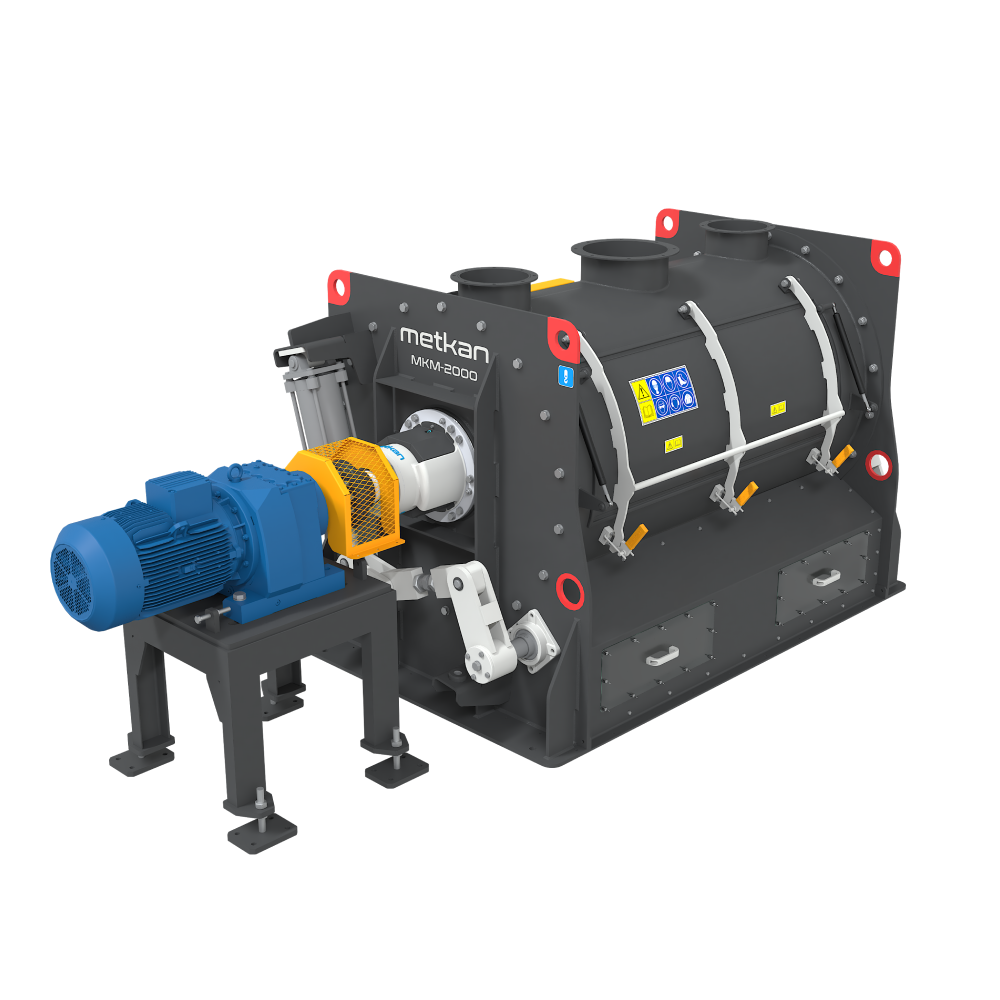
Horizontal powder mixer capacityis one of the fundamental criteria that directly determines the efficiency of the production line. This is because a mixer does not merely combine raw materials; it also shapes cycle times, daily production volumes, product standards, and end-of-line flow. A mixer with insufficient capacity slows down the entire line.Conversely, a mixer that is oversized unnecessarily inflates the investment budget and complicates process balance. Therefore, calculating the correct capacity cannot be done by looking at vessel volume alone; factors such as product density, recipe composition, mixing time, discharge speed, and daily production targets must all be considered together.
Construction chemicals, mineral-based mixtures and powder products in the production of mixer capacity becomes even more critical. This is because raw materials in such lines possess varying densities, particle structures, and flow characteristics. One recipe may mix quickly, while another requires more time. Some products discharge rapidly from the mixer, whereas others require a more controlled exit. Consequently, How is horizontal powder mixer capacity determined? it would be incorrect to give a one-line answer to the question. A sound capacity decision aligns production targets with process realities. For Metkan Makine, selecting the right capacity embodies precisely this approach: establishing a system that integrates seamlessly with the line, maintains mixing quality, and ensures a sustainable production rhythm.
Contents
- Why must horizontal powder mixer capacity be calculated accurately?
- Which data are considered first when calculating capacity?
- How does product density affect mixer capacity?
- Why do recipe composition and product variety alter capacity?
- How does the fill level determine mixer performance?
- Why does mixing time play a critical role in capacity calculation?
- How does discharge time affect the total cycle?
- How is the relationship between the daily production target and mixer volume established?
- What mistakes are made when selecting the capacity of a horizontal powder mixer?
- What benefits does selecting the correct capacity bring to the production line?
- Frequently Asked Questions
Why must horizontal powder mixer capacity be calculated accurately?
Horizontal powder mixer capacity It directly affects the production plan, as this machine determines the product output per cycle. If the mixer’s capacity falls short of actual requirements, the operator must perform more cycles to meet the daily target. This increases energy consumption, workload, and equipment wear and tear. It also causes downtime along the line: the bagging section sits idle while material backs up at the feeding end, causing fluctuations in the production pace. In such a scenario, overall efficiency fails to reach the desired level, even if the facility's other machines are high-performance units.
Conversely, selecting a mixer that is larger than necessary does not yield optimal results either. While a large volume might seem advantageous at first glance, not all products behave the same way regarding fill rates and mixing cycles. A large vessel increases investment costs and space requirements. It can also make it difficult to achieve a perfectly homogeneous mix for certain recipes. Therefore, the right choice cannot be made based simply on the logic that "bigger is better." The primary goal is to determine the appropriate volume for production needs using technical data. A precise calculation establishes a balanced line that optimizes both quality and capacity.
Which data are considered first when calculating capacity?
The first step in calculating capacity is to clearly define the product type to be manufactured, as different products exhibit different mixing characteristics. Next, hourly and daily production targets are established. The subsequent stage involves analyzing factors such as raw material bulk density, the number of ingredients in the recipe, mixing time, and discharge time. Without this data, mixer volume it is impossible to make a sound decision regarding mixer volume. Relying solely on the question of "how many tons will be produced per day" is insufficient.
In addition, the facility's operational workflow is taken into account. Will it operate on a single shift or a double shift? Will there be product changes during the day? Will different recipes be mixed on the same line? These questions directly influence capacity decisions, as there is a direct relationship between the number of cycles and the daily production volume. For Metkan Makine, calculating the correct capacity involves more than just selecting a machine size; the primary goal is to strike a balance that meets daily production targets without compromising mixture quality.
How does product density affect mixer capacity?
Product density is one of the most critical technical parameters for determining mixer capacity, as the same volume does not yield the same tonnage for every product. Even if the volume remains constant, higher density results in greater weight per cycle, whereas lower density yields lower tonnage for the same volume. Consequently, capacity calculations are not based solely on liters or cubic meters; the product's actual bulk density is also factored in.
For instance, recipes with heavy mineral content and those with lightweight additives will yield different outputs per cycle when processed in the same mixer body. A selection process that overlooks this difference disrupts daily production calculations; an operator might expect to meet the target on paper, only to find a different reality on the shop floor. Therefore, product density is not merely a matter of formula details; it is a fundamental multiplier that converts mixer volume into tonnage. Accurate and up-to-date data on this parameter is essential for making sound capacity decisions.
Why do recipe composition and product variety alter capacity?
The recipe structure directly affects mixing time, discharge behavior, and product homogeneity. Multi-component recipes require greater care during mixing. Formulas combining fine powders with granular additives necessitate a different approach to the mixing cycle. Homogeneity is achieved more quickly for some products, while others require a longer mixing time. Therefore, mixer capacity when selecting [the equipment], the total tonnage target is not the only factor considered; the complexity of the recipes to be produced is also taken into account.
As product variety increases, so does the flexibility required of the mixer. If multiple products are to be manufactured on the same line, not every recipe adheres to the same cycle time. Furthermore, cleaning and transition times following product changes impact total capacity. Consequently, capacity calculations based on a single recipe yield incomplete results for multi-product facilities. Metkan Makine’s process approach therefore does not evaluate the mixing machine in isolation. Mixer volumeIt is considered in conjunction with the recipe structure and production scenario.
How does the fill level determine mixer performance?
The total volume of the mixer vessel and the effective mixing volume are not identical. This is because Horizontal powder mixer It does not operate when completely full. Space for movement inside is required for the mixing elements to turn the product over; therefore, the fill ratio plays a critical role. If the vessel is completely full, the flow of the mixture weakens, homogeneity decreases, and mixing performance deteriorates. Conversely, a very low fill ratio results in inefficient volume utilization and reduces the tonnage obtained per cycle.
The correct fill ratio falls within the range where the product moves freely and the mixture progresses in a balanced manner. This ratio varies depending on the product type, the mixing element, and the mixer design. When calculating capacity accurately, the effective working volume—not the total vessel volume—is used as the basis. If this distinction is overlooked, the mixer may appear adequate on paper but fail to deliver the desired efficiency in the field. Therefore, Horizontal powder mixer capacity one of the most critical answers to the question of how it is determined lies in the fill ratio.
Why does mixing time play a critical role in capacity calculation?
Mixing time It lies at the heart of the total cycle, as this duration directly determines how many batches the mixer produces per hour. Even if two mixers have the same volume, their hourly production rates will differ if their mixing times vary. If the product reaches homogeneity quickly, the number of cycles increases; if the mixing time is prolonged, total capacity drops. Consequently, looking solely at the vessel volume does not yield an accurate result.
Factors influencing mixing time include product density, recipe complexity, the structure of the mixing mechanism, and the target level of homogeneity. Construction chemicals For sensitive recipes, the operator cannot simply shorten the mixing time for the sake of speed. This is because homogeneity can be compromised if the duration is reduced. A sound capacity decision strikes this very balance. The goal is not merely to complete more cycles, but to maintain consistent quality across every cycle. For this reason, Metkan Makine approaches capacity planning hand-in-hand with quality discipline.
How does discharge time affect the total cycle?
Many businesses focus solely on mixing time when calculating capacity; however, discharge time is also a crucial part of the cycle. If the mixer does not discharge the product quickly and in a controlled manner, the cycle time extends, thereby reducing hourly output. Especially on high-volume lines, a difference of just a few minutes can lead to a significant change in total capacity by the end of the day. Therefore, the design of the discharge gate, product flow, and the readiness of downstream equipment must all be considered together.
Some recipes discharge easily from the mixer, while others flow with greater difficulty and take longer to empty. This difference plays a direct role in capacity calculations. Furthermore, if the bagging line or an intermediate hopper fails to receive the product on time, the mixer sits idle. In such cases, the problem appears to lie with the mixer, but the root cause actually lies in line synchronization. Therefore, Horizontal powder mixer capacity when determining capacity, discharge time is evaluated within the context of the overall line flow rather than in isolation. An accurate cycle calculation aggregates both the mixing and discharge times.
How is the relationship between the daily production target and mixer volume established?
The daily production target makes the capacity selection concrete. Knowing the desired daily tonnage clarifies how much the mixer needs to produce in a single cycle. Subsequently, the shift duration and the number of cycles are calculated. The appropriate volume is determined based on these two data points. Thus, the investment decision is grounded in a real production plan rather than mere estimation.
It is not correct to base calculations solely on ideal operating times. Product changes, maintenance breaks, recipe switches, and short pauses also affect the total time. Therefore, when selecting the mixer volume, the difference between theoretical capacity and actual on-site capacity must be taken into account. A facility that plans correctly maintains quality standards while meeting daily targets. This is precisely where Metkan Makine’s approach to process integrity stands out; because the right mixer volumebalances not just the mixing machine, but the entire production line.
What mistakes are made when selecting the capacity of a horizontal powder mixer?
The most common mistake is selecting a mixer based solely on total vessel volume. However, total volume and effective working volume are not the same. Another error is calculating tonnage without considering product density; in such cases, the capacity on paper does not match the reality on the shop floor. Some facilities underestimate mixing times, resulting in an inflated cycle calculation—an approach that disrupts the daily production schedule.
Yet another common mistake is considering the mixer in isolation from the rest of the line. If the feed line is inadequate... mixer ...waits. If the bagging line is not ready after discharge, the cycle time extends. Therefore, even if the problem appears to lie solely with the mixer capacity, the root cause may actually lie in the system balance. For an optimal choice, mixer, feeding, intermediate transfer and end-of-line ...must be evaluated together.
What benefits does selecting the correct capacity bring to the production line?
Selecting the right capacity establishes balance across the line from the start. The feeding section and the mixing section operate in sync. The bagging line does not have to wait for the product. The operator manages the cycle schedule more clearly. This arrangement boosts both labor efficiency and daily production discipline. Furthermore, the machinery is not subjected to unnecessary strain, and maintenance scheduling becomes more controlled.
Additionally, selecting the right capacity improves the return on investment. The facility avoids bottlenecks caused by insufficient volume and avoids straining its budget with unnecessarily large machinery. Product quality becomes more consistent. The cycle schedule becomes predictable. For Metkan Makine, the right choice Horizontal powder mixer capacity...is not merely about selecting a machine; it is a decision to establish a production line that is efficient, sustainable, and manageable on an enterprise scale.
Frequently Asked Questions
How is horizontal powder mixer capacity calculated?
Horizontal powder mixer capacity ...product density, effective working volume, mixing time, discharge time, and the daily production target are all evaluated together. Looking solely at the vessel volume does not yield an accurate result. A reliable calculation combines the tonnage obtained per cycle with the number of cycles per hour in a single analysis.
Is the mixer volume the same as the actual production capacity?
No, they are not the same. There is a difference between the total body volume and the effective mixing volume. Mixer It does not operate at full capacity; the product needs space to move inside.
Why does product density have such a significant impact on capacity?
Because the same volume does not yield the same tonnage for every product. A high-density product creates more weight within the same body, whereas a low-density product yields less tonnage for the same volume. Therefore, product density is a key factor in capacity calculations.
Why does capacity decrease if the mixing time is extended?
When the mixing time increases, the number of cycles completed per hour decreases. As the number of cycles drops, the total production volume also falls. While rapid cycling may seem advantageous, homogeneity must not be compromised. The correct duration strikes a balance between quality and capacity.
Why is discharge time important in capacity calculations?
Because a cycle consists of more than just the mixing time; the time it takes for the mixer to discharge the product also determines the total duration. A system with a slow discharge rate extends the cycle and reduces hourly capacity.
Does every recipe yield the same mixer capacity?
No. As the recipe composition changes, the mixing time, discharge speed, and product density also change. Formulas with multiple components and varying particle structures do not yield the same cycle times.
Is a large-volume mixer always more advantageous?
No. An oversized mixer increases investment costs and does not deliver efficient results for every formula. The key is to determine the volume that matches the facility's actual production needs. The right volume ensures both quality maintenance and budget balance.
What is the most common mistake made when selecting mixer capacity?
The most common mistake is equating the total vessel volume directly with capacity. Failing to account for product density and underestimating mixing times are also frequent errors. To make a sound choice, all process data must be evaluated holistically.
Metkan Makine By accurately determining the horizontal powder mixer capacity suited to your production line, you can establish a more balanced, efficient, and sustainable mixing process. To clarify the optimal mixer volume, cycle structure, and line compatibility for your project... please contact us..