What Causes Screw Conveyor Blockages?
Production continuity in powder and granule conveying lines...depends on the steady flow of material. The screw conveyor constitutes a key component of this flow. The process proceeds smoothly when the system conveys material at the specified capacity; however, flow issues arise when feed rates, material properties, or equipment settings change. Screw conveyor clogging...directly reduces production capacity. A clog increases the motor load, places strain on the gearbox, and interrupts material flow. Furthermore, recurring issues lead to increased unplanned downtime. The operation suffers significant time loss when operators must repeatedly stop the line to clear blockages.
The source of the problem is not always the screw itself. Sometimes, the hopper feeds material unevenly. In certain processes, moisture causes the material to become sticky. Incorrect rotational speed, insufficient motor power, or unsuitable screw geometry can also disrupt the flow. Therefore, the entire process line must be evaluated to find the right solution. At Metkan, we approach powder and granule conveying systems within the context of the overall process. We evaluate material characteristics, target capacity, and equipment operating conditions holistically. This allows us to focus on the root cause of the problem rather than just the consequences of the clogging.
Contents
- How does a screw conveyor work?
- What causes screw conveyor clogging?
- How does overfeeding lead to clogging?
- How do material properties affect flow?
- Why are moisture and stickiness important?
- Why is the selection of screw diameter and pitch critical?
- What problems arise from low or high rotational speeds?
- Does the choice of motor and gear reducer affect clogging?
- Why do discharge point issues cause material backup?
- How does hopper design affect screw conveyor performance?
- How can screw conveyor clogging be prevented?
- Which points should be checked during maintenance?
- Metkan screw conveyor solutions
- Frequently Asked Questions
How does a screw conveyor work?
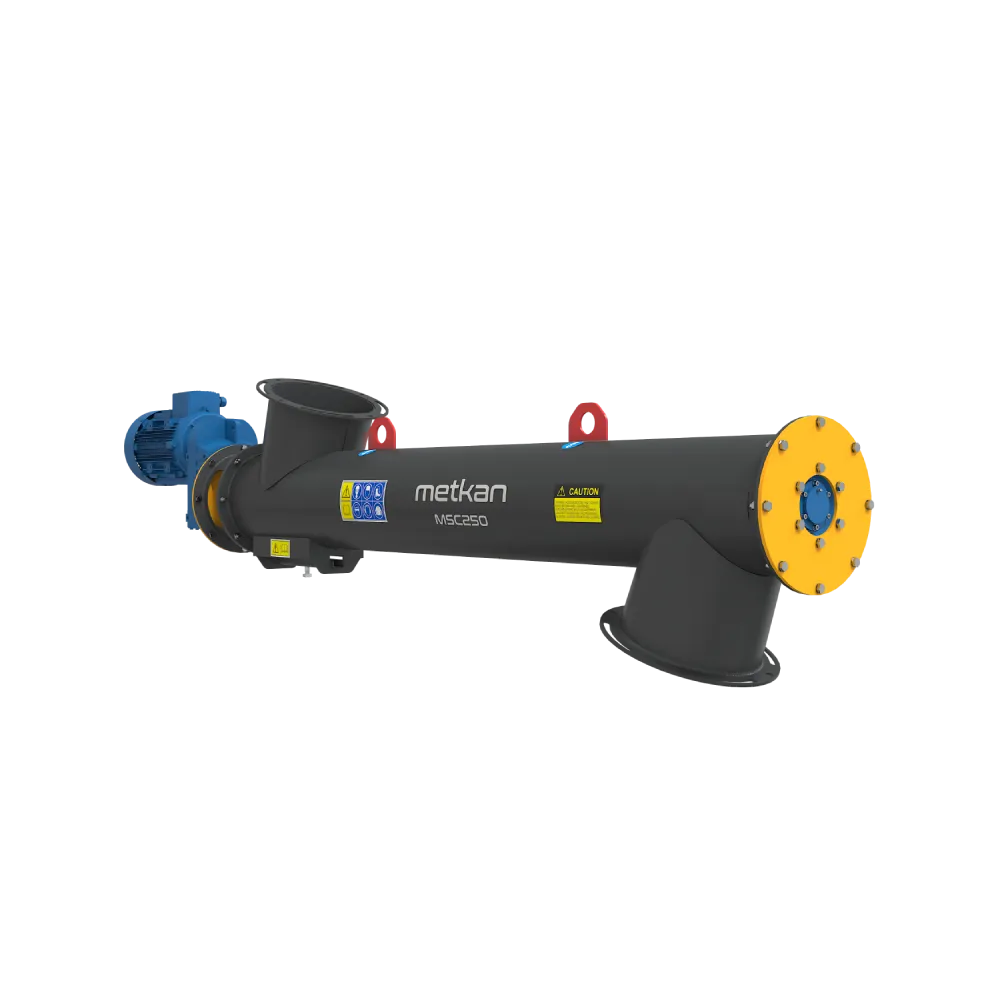
A screw conveyor advances material along a line using a rotating spiral structure. The motor transmits motion to the gearbox, which rotates the screw shaft at a specified speed. Spiral flights transport the material from the inlet to the discharge point. This system offers significant advantages, particularly for the controlled transfer of powdered and granular products. The enclosed casing limits dust dispersion into the environment. Additionally, the compact design facilitates installation in confined production areas. Facilities utilize screw conveyor systems—either horizontally or at specific inclines—to meet various process requirements.
However, the system's successful operation depends on selecting the right equipment. Screw diameter, pitch, rotational speed, and motor power must align with the material's characteristics. Furthermore, the feed rate must not exceed the conveying capacity. If any of these parameters fall out of balance, the material density within the screw increases. Consequently, the motor load rises, and the conveying speed drops. If the issue persists, the line becomes completely blocked.
What Causes Screw Conveyor Blockages?
There is no single cause for screw conveyor blockages; in most cases, multiple process issues occur simultaneously. Therefore, simply cleaning the blocked area does not provide a permanent solution. Overfeeding is one of the most common causes. When the product entering the inlet exceeds the screw's conveying capacity, the casing fills rapidly. The spiral flights become unable to advance the dense material, causing the motor to attempt to generate higher torque.
Material properties also play a significant role. Damp or sticky powders adhere to the casing surface. Over time, this layer builds up, narrowing the usable cross-sectional area. For granular products, irregular particle distribution can alter flow behavior. Additionally, incorrect screw geometry, insufficient motor power, and discharge issues can lead to clogging. Therefore, an accurate diagnosis requires inspecting the entire system from inlet to outlet.
How Does Overfeeding Cause Clogging in a Screw Conveyor?
Every screw conveyor operates based on a specific conveying capacity. This capacity is determined by the screw diameter, rotational speed, pitch, and material density. If the feeder supplies product beyond this limit, the system loses its balance. For instance, if a hopper transfers a large volume of material to the screw in a short time, the inlet zone fills up rapidly. The screw cannot move the material away at the same rate; consequently, the product begins to jam in the inlet zone.
Overfilling also increases friction. The motor draws higher current, and the mechanical load on the gearbox rises. Subsequently, the protection system may stop the motor. If no protection system is in place, mechanical components are subjected to excessive stress. Therefore, a balance must be maintained between the feed rate and the screw's conveying capacity. Controlled feeding supports smooth system operation. Furthermore, an automation system can monitor the motor load and adjust the feed rate according to process conditions.
How Do Powder and Granule Properties Affect Flow?
Not all powders or granules share the same flow characteristics. Particle size, density, moisture content, and surface properties determine how the material moves within the screw. Free-flowing dry granules generally advance more steadily. In contrast, very fine powders may exhibit different behaviors; some fine products can compact and form a dense layer. Some materials may become airborne, resulting in irregular feeding.
Significant variations in particle size distribution also affect flow. Fine particles fill the voids between coarse granules, thereby altering the material's bulk density. The screw motor must then contend with this new load condition. For this reason, at Metkan, we do not base equipment sizing solely on the t/h (tonnes per hour) value; we also analyze the material's physical characteristics. After all, the proper design of a screw conveyor is shaped by the product's actual flow behavior.
Why Do Moisture and Stickiness Increase the Risk of Clogging?
Moisture significantly alters flow behavior, particularly with fine powders. A product that flows easily when dry may adhere to the casing and the screw flights upon absorbing moisture. Initially, a thin layer of product forms. As the system continues to operate, new material sticks to this layer. Consequently, the usable space within the screw conveyor progressively shrinks. As a result, the same quantity of product is forced to pass through a narrower cross-section.
Adherent material also diminishes the conveying efficiency of the screw flights. Instead of propelling the product forward, the spiral structure may simply rotate it in place. This reduces conveying capacity. Therefore, the material's moisture content must be considered during process design. Storage conditions are also crucial; preventing the product from absorbing moisture prior to processing significantly lowers the risk of clogging.
Why Are Screw Diameter and Pitch Selection Critical?
Screw diameter directly affects conveying capacity. When a small-diameter system attempts to handle a high material flow rate, the fill ratio rises rapidly, increasing the risk of clogging. Pitch refers to the distance between the spiral flights; this distance determines how much material is moved forward with each rotation of the screw. Thus, the pitch must be selected based on the material's characteristics and the target capacity.
Operations should not attempt to achieve high capacity from a small screw conveyor simply by increasing the rotational speed. High speeds do not yield the same results for every product; with some materials, friction and wear increase, and the product's structure may be damaged. At Metkan, we evaluate the screw diameter and geometry in conjunction with the target capacity. This ensures the system meets not only theoretical capacity requirements but also actual operating conditions.
What Problems Arise from Selecting the Wrong Screw Speed?
Rotational speed is a fundamental parameter of screw conveyor performance. Excessively low speed reduces conveying capacity; if the feed rate remains constant, the volume of material inside the casing increases, eventually leading to a blockage. Conversely, excessively high speeds create different issues. The screw agitates the material more than necessary, altering product behavior—particularly with fine powders—and subjecting bearings and other mechanical components to increased loads.
The correct speed strikes a balance between target capacity and material characteristics. Therefore, operations should not focus solely on maximum motor speed. Frequency-controlled systems offer significant advantages under varying operating conditions, allowing the operator or automation system to adjust motor speed based on process requirements. This enables the screw to respond more precisely to fluctuating feed rates.
Do Motor and Gearbox Selection Affect Blockages?
The motor and gearbox provide the motion and torque required by the screw. Incorrect power selection directly impacts system performance. Insufficient motor power leads to a loss of speed under heavy loads; as the screw slows down, material accumulates within the casing, further increasing the load and trapping the system in a self-escalating cycle of blockage.
However, selecting an oversized motor does not solve the underlying problem either. An excessively powerful motor may continue to force the system despite a mechanical jam. This places high loads on the shaft, bearings, and gearbox. Therefore, motor power, gear ratio, and screw geometry must be calculated in conjunction. Metkan determines these parameters based on target capacity and product characteristics, ensuring the drive system operates under conditions suited to the process requirements.
Why Do Discharge Point Issues Cause Material Backup?
A screw conveyor transports product from the inlet to the discharge point. However, if the downstream equipment lacks sufficient capacity, the product backs up within the screw. For instance, consider a screw conveyor feeding product into a hopper; once the hopper is full, the product cannot move away from the discharge point. If the screw continues to operate despite this, the volume of material inside the casing increases rapidly.
The same situation arises when the downstream conveyor operates at low capacity. Therefore, even if the problem appears to be within the screw conveyor itself, the root cause may lie in a later section of the line. Level sensors play a crucial role here. The system monitors the bunker level; when the product reaches a critical level, the automation system halts the feed, thereby reducing the risk of material backup.
How Does Bunker Design Affect Screw Conveyor Performance?
The relationship between the bunker and the screw conveyor directly determines material flow. Improper bunker geometry leads to irregular product feeding; at times, the screw receives too little product, while at others, it faces an overload. Bridging is a significant issue, particularly with powdery products, where the material forms a self-supporting structure inside the bunker that blocks the outlet. Eventually, this structure collapses suddenly, causing a surge of product to reach the screw. This sudden load can exceed the screw's capacity, causing motor current to spike and the system to jam.
For this reason, the bunker outlet and the screw conveyor capacity must be designed in tandem. Appropriate flow-assist systems are employed when necessary; however, a single solution does not work for every product. Material characteristics form the foundation of the design.
Do Worn Screw Flights Cause Flow Problems?
Screw flights wear down over time. Abrasive granular and mineral products, in particular, reduce flight thickness. As the flight geometry changes, conveying performance declines. This wear may go unnoticed initially; the motor continues to run, but the system transports less product at the same rotational speed. If the feed rate remains constant, the fill level within the screw increases.
Furthermore, uneven wear can disrupt product flow. Therefore, the operator should not limit inspections to the motor and gearbox; the flight thickness and spiral geometry must also be examined periodically. Scheduled inspections reveal capacity loss at an early stage, allowing the operator to plan maintenance before a blockage occurs.
How Can Screw Conveyor Blockages Be Prevented?
The most effective way to prevent blockages is to operate the system at the correct capacity. First, the feed rate must be matched to the screw's capacity. Next, the motor load should be monitored regularly. Changes in material properties must also be tracked; an increase in moisture, in particular, serves as an early warning signal. Conveying capacity should be re-evaluated whenever the product's bulk density changes.
Additionally, the discharge line must operate without interruption. If downstream equipment stops, the automation system should halt the screw feed as well; this control measure prevents material backup. Regular maintenance also plays a crucial role. Bearings, flights, connections, and the drive system should be inspected at set intervals. This ensures that minor issues are resolved before they escalate into production downtime.
What Points Should Be Checked During Maintenance?
The maintenance team should first inspect the physical condition of the screw flights. Wear, deformation, or product buildup directly affects conveying capacity. Next, the shaft and bearing points should be examined. Abnormal noise or vibration indicates a mechanical problem. A continuous rise in motor current also indicates an increasing load. The gearbox oil level and operating temperature also require regular monitoring. Additionally, coupling connections and fastening elements should be included in the inspection checklist.
Maintaining organized operational maintenance records allows for identifying correlations between malfunctions. For instance, if product accumulation consistently occurs at the same location, the issue is not merely a matter of cleaning. In such cases, the equipment geometry or process conditions should be re-evaluated.
What Data Should Be Monitored to Improve Screw Conveyor Performance?
Data-driven monitoring significantly reduces the risk of clogging. To achieve this, the operation must regularly monitor motor current. A rise in current indicates an increase in the screw load at an early stage. The hourly conveying rate is also a key indicator; if capacity drops while the motor load rises, there may be friction or material accumulation within the system.
Unplanned downtime must also be recorded. Based on this data, the facility can identify which products and operating conditions lead to recurring blockages. This information also guides the maintenance plan, ensuring the team does not merely react after a breakdown occurs; instead, they can anticipate an impending issue and schedule the necessary checks.
Metkan Screw Conveyor Solutions
At Metkan, we do not view screw conveyor systems merely as standalone conveying equipment. We also analyze how the system interacts with its feed and discharge points, as true process performance depends on the equipment working in unison. We begin by evaluating the physical properties of the product to be conveyed, then determine the target capacity and conveying distance. We also take layout constraints into account. Based on this data, we design the screw geometry and drive configuration.
When addressing flow problems in existing lines, we focus on the root cause of the issue. We examine feed rates, motor loads, and discharge conditions collectively. This allows us to evaluate not just the blocked section, but the specific process conditions that caused the blockage. Proper sizing, controlled feeding, and regular maintenance enhance screw conveyor performance while simultaneously reducing unplanned downtime and production losses.
Frequently Asked Questions
Why do screw conveyors frequently get blocked?
Frequent blockages usually indicate a mismatch between capacity and process conditions. Overfeeding, high product moisture, or incorrect screw geometry can trigger the problem. Material backing up from the discharge line can also lead to the same result.
Does moist dust cause problems in a screw conveyor?
Yes. Moisture increases the stickiness of certain powdered products. The product adheres to the casing and the flights. As the buildup grows, the conveying cross-section narrows, increasing the risk of clogging.
Does increasing the screw speed resolve clogging?
Not always. With some products, high speeds create more friction rather than improving flow. The operating speed should be determined based on the material's characteristics and the target capacity.
Does increasing motor power prevent clogging?
A larger motor does not eliminate the root process problem. If improper feeding or material backup persists, the system will still experience issues. Furthermore, excessive motor power increases the load on mechanical components.
What factors determine screw conveyor capacity?
Screw diameter, pitch, speed, and material density are the primary factors determining capacity. The conveying angle and the product's flow characteristics also influence the outcome. Therefore, capacity calculations must take product properties into account.
Can the hopper cause screw conveyor clogging?
Improper hopper design leads to irregular feeding. When bridged material suddenly collapses, a large volume of material enters the screw. This sudden load increases the risk of clogging.
How can wear on the screw flights be detected?
A drop in capacity is one of the first signs of trouble. If the system conveys less product while the motor continues to operate as usual, the screw flights should be inspected. A visual inspection can also reveal changes in flight thickness and geometry.
How can clogging in screw conveyors be minimized?
Operations should begin with the correct equipment capacity. Controlled feeding, appropriate rotational speed, and regular maintenance reduce the risk of clogging. Additionally, monitoring motor load and hopper levels via automation enhances process control.
Plan Your Screw Conveyor Line Correctly with Metkan
Recurring clogs in screw conveyors do more than just slow down production; they also increase the load on the motor, gearbox, and mechanical components. Therefore, operations should not attempt to resolve the issue solely by clearing the blockage.
At Metkan, For dust and granule conveying lines, we evaluate material characteristics, target capacity, feeding patterns, and equipment operating conditions holistically. To determine the right process solution for new screw conveyor investments or to address flow problems in your existing line, contact Metkan.