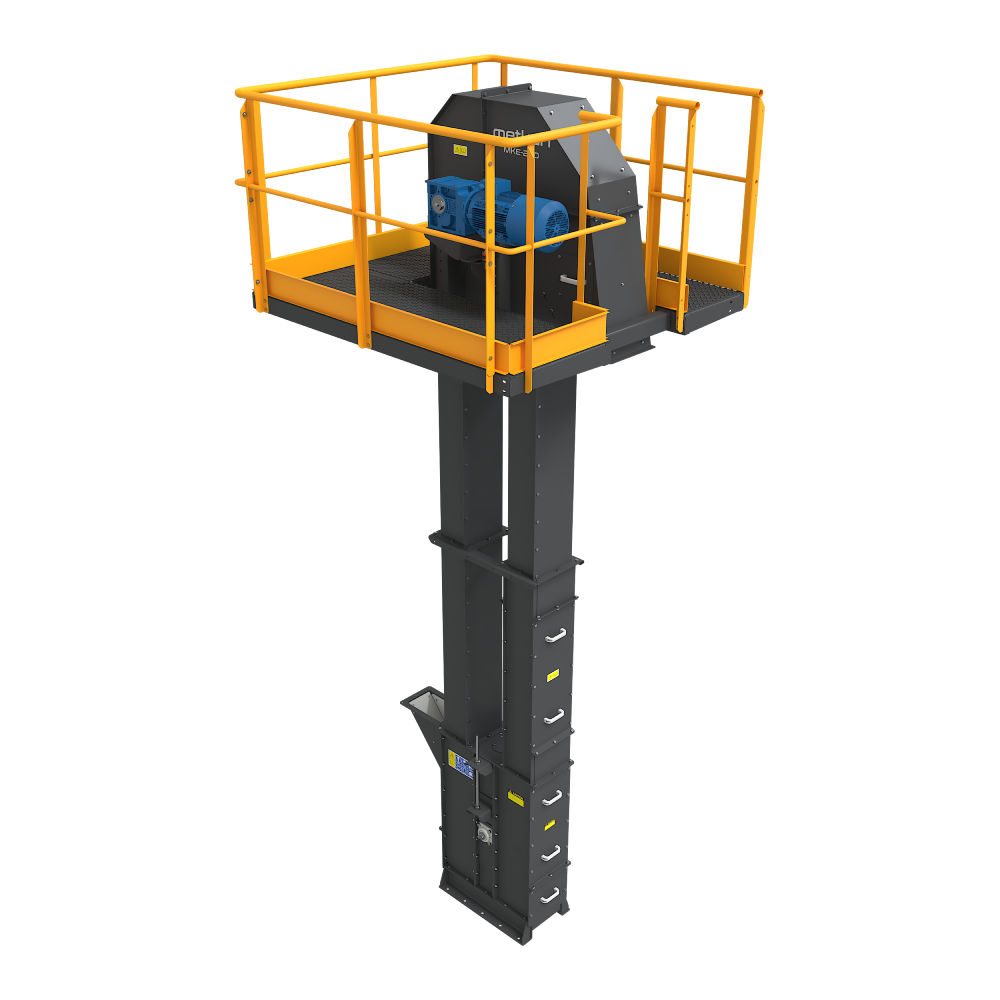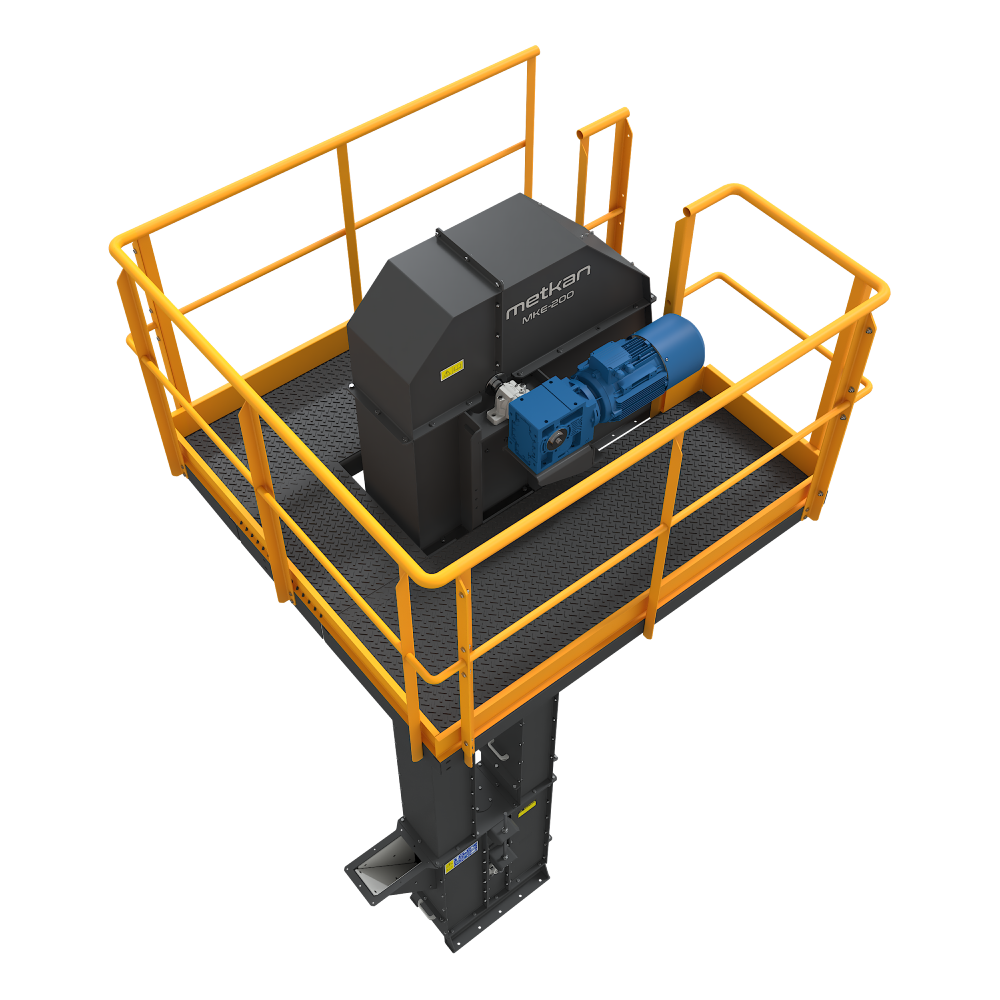
The bucket elevator is a critical piece of equipment that ensures high efficiency in production lines requiring vertical material conveyance.Industries such as construction chemicals, mining, aggregates, cement, gypsum, agriculture, food processing, and chemical manufacturing make extensive use of this system. Therefore, the issue of material rollback in bucket elevators signifies more than just a minor loss of product; rather, it directly impacts the entire line's capacity, energy consumption, cleaning requirements, maintenance intervals, and production continuity.When businesses analyze this problem early on, they can reduce mechanical failures and achieve a more stable flow within the production line.
Back-spilling occurs when the bucket fails to properly transfer the material it carries to the discharge point. Material may spill out of the bucket prematurely, fall into the casing before reaching the discharge chute, or drop back down to the elevator's boot section after discharge. This phenomenon is particularly pronounced with dusty, granular, moist, sticky, or abrasive products. Furthermore, incorrect speed selection, the wrong bucket type, unbalanced feeding, an unsuitable discharge angle, and a lack of maintenance exacerbate the problem. Therefore, businesses should not view the question "Why does a bucket elevator spill material back?" solely through the lens of a malfunction. The correct approach requires a holistic examination of the system, from the feed point to the discharge area. At this stage, Metkan Makine leverages its expertise in engineering, manufacturing, and plant integration.
Contents
- What is back-spilling in bucket elevators?
- How does back-spilling affect the production line?
- How does incorrect bucket selection lead to back-spilling?
- Why are bucket speed and rotation settings important?
- How do material properties increase back-spilling?
- What are the common errors at the feed point?
- Why does the design of the discharge zone play a critical role?
- How do errors in bucket spacing and arrangement cause problems?
- What do wear, lack of maintenance, and mechanical loosening lead to?
- How do belt, chain, and tensioning issues affect material fallback?
- What precautions are necessary for dusty and moist products?
- How can material fallback be prevented in a bucket elevator?
- Metkan Makine bucket elevator solutions
- Frequently Asked Questions
What is material fallback in a bucket elevator?
Material fallback in a bucket elevator...refers to the product carried by the buckets falling back into the system or the lower casing before reaching the discharge point. This problem often manifests as reduced capacity, product accumulation, internal casing friction, excessive dusting, and the need for frequent cleaning. Initially, operators may only notice symptoms such as the line running slowly or irregular product flow. However, a detailed inspection reveals that the root cause is material fallback. Especially on continuously operating lines for construction chemicals and aggregates, even small amounts of product loss can accumulate into significant volumes by the end of a shift. Therefore, material fallback is a critical mechanical issue that impacts production quality and plant efficiency.
However, material fallback does not occur for the same reason in every system. In some facilities, the bucket geometry does not match the material's flow characteristics. In others, the speed setting causes the product to be discharged prematurely due to centrifugal force. In some cases, the feeding system fills the buckets unevenly, causing a portion of the product to fall back down during each rotation. Therefore, the operator should not simply replace the buckets to resolve the issue. First, factors such as product type, density, particle size, moisture content, elevator height, drive configuration, discharge angle, and feeding arrangement must be analyzed collectively.Additionally, material accumulating inside the casing increases mechanical friction. This situation both shortens the equipment's lifespan and raises the risk of unplanned downtime.
How Does Material Fallback Affect the Production Line?
Material fallback in a bucket elevatorIt directly reduces the production line's capacity because the system attempts to convey the same material repeatedly, resulting in decreased net product transfer. Losses that appear minor at first glance can escalate into serious performance issues on high-tonnage lines. Furthermore, product accumulation in the lower casing impedes the rotational movement of the buckets and increases the load on the motor, leading to higher energy consumption. Friction also places additional strain on the chain or belt. Consequently, the facility faces more frequent maintenance requirements, higher spare parts consumption, and unexpected production stoppages. Ultimately, material fallback is not merely a technical glitch but an efficiency problem that directly drives up costs.
Furthermore, Spillage also impacts occupational safety and cleaning processes.. With dusty products, leakage escaping the casing creates an adverse working environment. With moist or sticky products, accumulations harden and extend cleaning times. In the case of abrasive materials, spilled product causes increased wear at the elevator boot and return sections. This increases the maintenance team's workload. Furthermore, irregular product flow impairs the performance of downstream equipment; for instance, mixers, silos, screens, or bagging lines fail to receive a steady feed. Therefore, a manufacturer should not view the bucket elevator merely as vertical conveying equipment. The system is a critical link that determines the balance of the entire process flow.
How Does Incorrect Bucket Selection Cause Spillage?
Bucket selection is one of the most significant factors determining spillage issues, as not all materials can be conveyed efficiently using the same bucket design. Fine powders, granular raw materials, coarse aggregates, moist mixtures, and sticky products exhibit different retention and discharge behaviors. Bucket volume, depth, front lip design, sidewall shape, and discharge angle directly influence this behavior. An unsuitable bucket fails to adequately retain the product during conveyance or transfer it in a controlled manner at the discharge point.. In such cases, the product either spills prematurely or remains in the bucket and travels back down during the return run. In either scenario, the system experiences spillage problems.
Additionally, businesses sometimes opt for larger buckets to increase capacity. However, a large bucket does not always yield higher efficiency. If a bucket is overfilled, the product spills over the top edge and begins to fall out in the return zone. Conversely, choosing a small bucket fails to provide sufficient conveying volume, preventing the system from meeting its capacity targets. Therefore, the right choice should not be based merely on a "large vs. small bucket" mindset. Metkan Makine Manufacturers who employ a plant engineering approach evaluate product characteristics and line capacity in tandem. This ensures that the bucket design is optimized for the product flow and the elevator's operating speed.
Why Are Bucket Speed and Rotation Settings Important?
In bucket elevators, speed adjustment directly determines the material's discharge behavior.If the system operates at excessive speeds, the buckets subject the product to intense centrifugal force. In this scenario, the material is flung into the elevator casing before reaching the intended discharge point.. This effect is particularly pronounced with fine-grained, lightweight, or powdery products. If the facility increases the speed to boost capacity, it fails to achieve the expected yield; instead, it experiences increased material fallback. Furthermore, high speeds increase mechanical stress on bucket connections and the drive system. Therefore, speed adjustment must be evaluated not only based on motor RPM but also in conjunction with material flow and discharge geometry.
On the other hand, low speed also leads to a different type of inefficiency. When the bucket reaches the discharge point, the product fails to attain sufficient kinetic energy and remains inside the bucket rather than flowing into the discharge chute. Subsequently, as the bucket begins its return movement, the material spills downward. Consequently, the optimal speed range is central to the system design. The correct speed ensures the product is transported safely within the bucket and transferred in a controlled manner at the discharge point. Additionally, frequency-controlled drive systems offer the advantage of greater operational flexibility across different product types. This allows the facility to transport materials with varying densities and flow characteristics more consistently using a single piece of equipment.
How Do Material Properties Increase Fallback?
The physical properties of the conveyed material directly affect bucket elevator performance. Density, particle size, moisture content, flowability, adhesiveness, and abrasiveness are among the key parameters determining the risk of fallback. For instance, lightweight and powdery products are more susceptible to the effects of air movement. Consequently, in high-speed systems, the product is flung about uncontrollably. With coarse-grained products, the filling balance within the bucket is disrupted, causing material to spill over the bucket's edge. Furthermore, abrasive products wear down the bucket surface and fasteners over time; this wear alters the bucket geometry and increases material fallback.
The situation differs when dealing with moist or sticky products.. Material adheres to the bucket surface and does not fully detach at the discharge point. Subsequently, as the bucket rotates downward, the product falls back into the system. This issue requires particular attention with construction chemicals, gypsum, lime, certain mineral mixtures, and moist granular products. Additionally, a tendency for the product to clump leads to uneven filling at the feed point. Therefore, when selecting a bucket elevator, the operator should not focus solely on hourly capacity but must also analyze the material's behavior under actual operating conditions. Metkan Makine This approach considers the facility as a whole and tailors the elevator design to the product's characteristics.
What Are the Errors at the Feed Point?
The feed point is one of the critical areas determining the risk of material fallback in a bucket elevator.If material does not enter the bucket in a balanced manner and at the correct angle, the system fails to operate efficiently. Irregular feeding causes some buckets to overfill while others are underfilled. Overfilled buckets spill product during the rotation movement, causing material to fall into the lower casing, whereas underfilled buckets reduce overall capacity. Additionally, sudden accumulations of material at the feed point strain bucket movement and increase mechanical vibrations. Over time, these vibrations cause fasteners to loosen. Consequently, material fallback becomes an issue linked not only to product flow but also to mechanical integrity.
Furthermore, the capacity of the feeding equipment must be compatible with the elevator's capacity. If a screw conveyor, belt conveyor, bunker outlet, or dosing system feeds too much product to the elevator, the buckets cannot fill in a controlled manner. Conversely, under-feeding increases the rate of empty buckets and reduces the system's expected conveying efficiency. Therefore, product flow at the feed point must be continuous. Furthermore, the material entry angle must be designed to align with the direction of bucket movement. Product arriving at an incorrect angle scatters inside the casing instead of settling into the bucket. Thus, an operation seeking to minimize fallback should prioritize the feed point as a key area for inspection.
Why Does Discharge Zone Design Play a Critical Role?
The discharge zone is the most critical design area of a bucket elevator, as it ensures the product is transferred to its target destination. When the bucket reaches the upper section with the product, the material must flow in a controlled manner toward the discharge chute. However, if the discharge opening is incorrectly positioned, the product falls into the elevator casing before reaching the chute. If the discharge channel is designed too narrowly, the product flow becomes constricted, causing backflow. Furthermore, if the discharge angle does not match the material's density and flow characteristics, the product remains inside the bucket. Therefore, the discharge zone should be designed based on the behavior of the conveyed product rather than relying on standard dimensional formulas.
The internal surface structure of the discharge chute also affects backspill. Chutes that are rough, narrow, or feature sharp turns slow down the product flow. Issues such as air entrapment with dusty products, impact effects with granular products, and the risk of adhesion with moist products increase.This prevents the consistent transfer of the product to the downstream equipment. Consequently, even if the elevator appears to be operating at capacity, irregularities in the feed occur further along the line. When developing turnkey plant solutions, Metkan Makine evaluates the elevator not in isolation, but in conjunction with silos, mixers, screens, crushers, conveyors, and bagging lines. This approach minimizes the risk of backspill in the discharge zone.
How Do Bucket Spacing and Arrangement Errors Cause Problems?
Bucket spacing directly affects system capacity and material flow. When buckets are positioned too close together, the product moves erratically in the discharge zone. Material exiting one bucket enters the path of the next and spills back into the casing. Furthermore, closely spaced buckets complicate maintenance and cleaning. Conversely, excessively wide spacing reduces the system's conveying capacity, preventing the facility from achieving its target tonnage. Therefore, bucket spacing must be calculated in conjunction with elevator height, product density, bucket volume, and line capacity. Proper spacing is essential for both consistent filling and controlled discharge.
Misalignment in the bucket arrangement also increases material fallback. When buckets travel off-axis, the product does not sit stably within them. This situation amplifies oscillation, particularly in tall elevators. It also leads to loose mounting bolts, uneven bucket lip levels, and irregularities in chain or belt movement. Consequently, product flow varies with each rotation. Operators often perceive this as a fluctuation in capacity, whereas the root cause is a mechanical imbalance in the bucket arrangement. Thus, installation quality and precise alignment are critical steps in preventing material fallback.
What Are the Consequences of Wear, Lack of Maintenance, and Mechanical Looseness?
Wear in bucket elevators, is one of the primary factors that exacerbates the problem of material fallback over time. Abrasive products—particularly aggregates, cement, gypsum, minerals, and the like—cause wear on bucket surfaces. When the bucket lip wears down, the product spills out more easily during conveying. As the bucket base thins, deformation increases and filling balance is compromised. Furthermore, when mounting holes enlarge, the buckets vibrate during operation. This vibration prevents the product from remaining stable within the bucket. Consequently, in systems lacking regular maintenance, material rollback becomes increasingly pronounced over time. At this stage, the operation must manage not only the breakdown itself but also the process leading up to it.
Mechanical loosening also negatively impacts system performance. Bolted connections, chain lugs, belt attachments, bearing housings, and drive components require regular inspection. Even minor clearances in these parts can escalate into significant vibrations during extended periods of operation. Additionally, a loose bucket loses its optimal position at the discharge point. This causes the product to be directed into the casing rather than into the discharge chute. Therefore, the maintenance team should establish a periodic checklist and inspect critical components without waiting for scheduled production shutdowns. Planned maintenance reduces rollback and extends the elevator's service life.
How Do Belt, Chain, and Tensioning Issues Affect Material Rollback?
The smooth operation of the conveying system is crucial for belt or chain bucket elevators. If the belt becomes loose, the buckets do not move stably, leading to oscillation. Chain elongation alters the bucket's position and disrupts the discharge geometry. Furthermore, incorrect tension causes slippage on the drive pulley or sprocket. Such issues prevent the product from reaching the discharge point at the consistent angle required. As the bucket moves differently with each rotation, it may release the material prematurely at times or carry it within the bucket at others. Consequently, internal back-spilling increases, and system capacity drops.
Mechanical load also increases when the tensioning system is not correctly adjusted. An overly tight belt exerts excessive pressure on bearings and pulleys, while a loose belt causes slippage, oscillation, and irregular rotation. In chain-driven systems, incorrect tension accelerates sprocket wear and disrupts bucket movement. Therefore, operators should not check tension settings only after a breakdown occurs; instead, they should establish a regular inspection schedule based on production intensity. Additionally, signs such as noise, vibration, capacity fluctuations, and product accumulation should be treated as early warning signals. This proactive approach prevents back-spilling from escalating into a major issue.
What Measures Are Required for Dusty and Moist Products?
Dusty products require special attention in bucket elevators.. This is because fine particles disperse easily due to high speeds, airflow, and turbulence during discharge.This makes it difficult to transfer the product into the discharge chute in a controlled manner. Furthermore, dust accumulation within the casing increases the need for cleaning and leads to a loss of efficiency in the working environment. For dusty materials, the correct bucket shape, appropriate speed settings, and a well-designed discharge chute play a critical role. Additionally, asealed casing structure and a controlled feeding system reduce product loss. When the facility implements these measures together, it can better manage both material fallback and dust leakage.
Different measures are required for moist and sticky products. When material adheres to the bucket surface, complete separation does not occur at the discharge point. Consequently, as the bucket moves downward, the product falls into the lower casing. This situation is particularly common with products that have variable moisture content. Therefore, the bucket surface structure, discharge angle, and operating speed must be determined based on product behavior. Additionally, adjustments should be made to the feed line to minimize clumping. Casing access panels that facilitate cleaning reduce maintenance time when necessary. This allows the facility to maintain production continuity while reducing losses caused by material fallback.
How to Prevent Material Fallback in Bucket Elevators?
To prevent material fallback, the first step is accurate diagnosis. The facility must first identify the point where the product falls back. Does the spillage occur during feeding, conveying, at the discharge zone, or during the return movement?The answer to this question directly determines the solution path. If overfilling occurs at the feed point, the dosing and entry angle should be checked. If the product falls back into the casing at the discharge zone, the discharge chute and speed setting should be examined. If the product remains inside the bucket during the return run, material adhesion or bucket geometry should be evaluated.
The second step is to optimize the system parameters. Bucket type, bucket spacing, elevator speed, motor power, tension settings, the discharge chute, and feeding equipment must be considered together. Changing a single component sometimes does not solve the problem, because a bucket elevator is a system where mechanical and process parameters work in tandem. Therefore, an engineering approach is required. Additionally, establishing a periodic maintenance plan prevents the recurrence of spillage. The system operates more stably when bucket wear, connection looseness, chain elongation, and belt oscillations are regularly checked.
The third step involves [selecting] equipment suited to the facility's production targets. ...is the choice to be made. Making a decision based solely on price during the new investment phase leads to higher costs in the long run. The business must evaluate product type, capacity, operating time, elevator height, environmental conditions, and ease of maintenance collectively. Furthermore, in turnkey plants, the compatibility of the elevator with other equipment is of great importance. Thus, the elevator becomes a robust piece of equipment that supports production continuity rather than becoming a weak point in the line.
Metkan Makine Bucket Elevator Solutions
Metkan Makine is a company established to manufacture high-quality machinery and turnkey plant solutions for the construction chemicals, mining, and aggregate sectors.. This production approach requires viewing bucket elevators not merely as standalone equipment, but as vital components of the plant's material flow. This is because an elevator delivers true efficiency only when it operates in harmony with crushers, screens, mixers, silos, screw conveyors, belt conveyors, bagging lines, and automation systems. Therefore, Metkan Makine develops bucket elevator solutions by taking into account product characteristics, capacity targets, and line layout. This minimizes material spillage, capacity fluctuations, and unnecessary maintenance costs.
Metkan Makine bucket elevator systems; cement, gypsum, Construction chemicals, agriculture, food and in chemical plants contributes to the controlled transport of granules, powders, and bulk materials. The company aims for efficient vertical conveying through robust casing structures, appropriate bucket designs, correct drive selection, and seamless plant integration. It also develops customized solutions tailored to the customer's specific production conditions. This approach yields superior results compared to purchasing standard equipment. Because every product has different flow characteristics and every facility has different capacity requirements. If your operation is experiencing issues such as material fallback in the bucket elevator, capacity loss, or frequent maintenance needs, you can contact Metkan Makine to request a solution tailored to your production line.
Frequently Asked Questions
What are the most common causes of material fallback in bucket elevators?
Material fallback in a bucket elevator It is most often caused by incorrect bucket selection, improper speed settings, and irregular feeding. Additionally, if the discharge chute is not positioned correctly, the product fails to reach the target point. Therefore, the operation should not attribute the problem to a single component but should examine the system as a whole.
Why do bucket elevators experience capacity loss?
Capacity loss often arises from material fallback, incomplete filling, excessive speed, bucket wear, or belt oscillation. When the system allows a portion of the conveyed product to fall back into the bottom casing, the net transfer rate decreases. This disrupts the feeding balance across the entire production line.
Does increasing the bucket speed reduce material fallback?
No, increasing the speed does not always provide a solution. Excessive speed causes the material to be thrown prematurely, especially with powdery or lightweight products. Therefore, before increasing the operating speed, the operation must evaluate product density, bucket shape, and discharge angle in conjunction.
Why do moist products cause problems in bucket elevators?
Moist products adhere to the bucket surface and do not fully separate at the discharge point. Subsequently, as the bucket begins its rotation, the product falls into the lower housing. Therefore, the bucket surface, speed settings, and discharge design require special attention when handling moist products.
Does maintenance on a bucket elevator reduce material fallback?
Yes, regular maintenance significantly reduces fallback. The system operates more stably when issues such as bucket wear, loose connections, belt oscillation, and chain elongation are detected early. Furthermore, scheduled maintenance lowers the risk of unplanned downtime.
What factors should be considered when selecting a new bucket elevator?
When selecting a new bucket elevator, factors such as product type, capacity, elevator height, bucket volume, speed settings, feeding method, and discharge point must be evaluated together. Compatibility with other system equipment is also important.
In which sectors are Metkan Makine bucket elevators used?
Metkan Makine bucket elevator systems are used to transport granules, powders, and bulk materials in sectors such as construction chemicals, cement, gypsum, mining, aggregates, agriculture, food processing, and chemical manufacturing. The company develops solutions tailored to specific product characteristics and facility capacities for every project.
Can material fallback be completely prevented?
Fallback can be largely controlled through proper design, correct speed, balanced feeding, and regular maintenance. However, every product behaves differently. Therefore, the facility should analyze the system with professional engineering support and implement a permanent solution.
Maximum efficiency in your bucket elevator systems in your bucket elevator systems and reduce product losses, Metkan Makine with contact us.